CONTACT US

We want to hear from you; get in touch by leaving a comment on one of our posts or by using the contact me button.
Showing posts with label Top tips and general advice. Show all posts

Monday, 9 February 2015

A fond farewell and last post to our Devon Sundowner


Our travels in our new campervan are documented at Back On The Road Again Blog

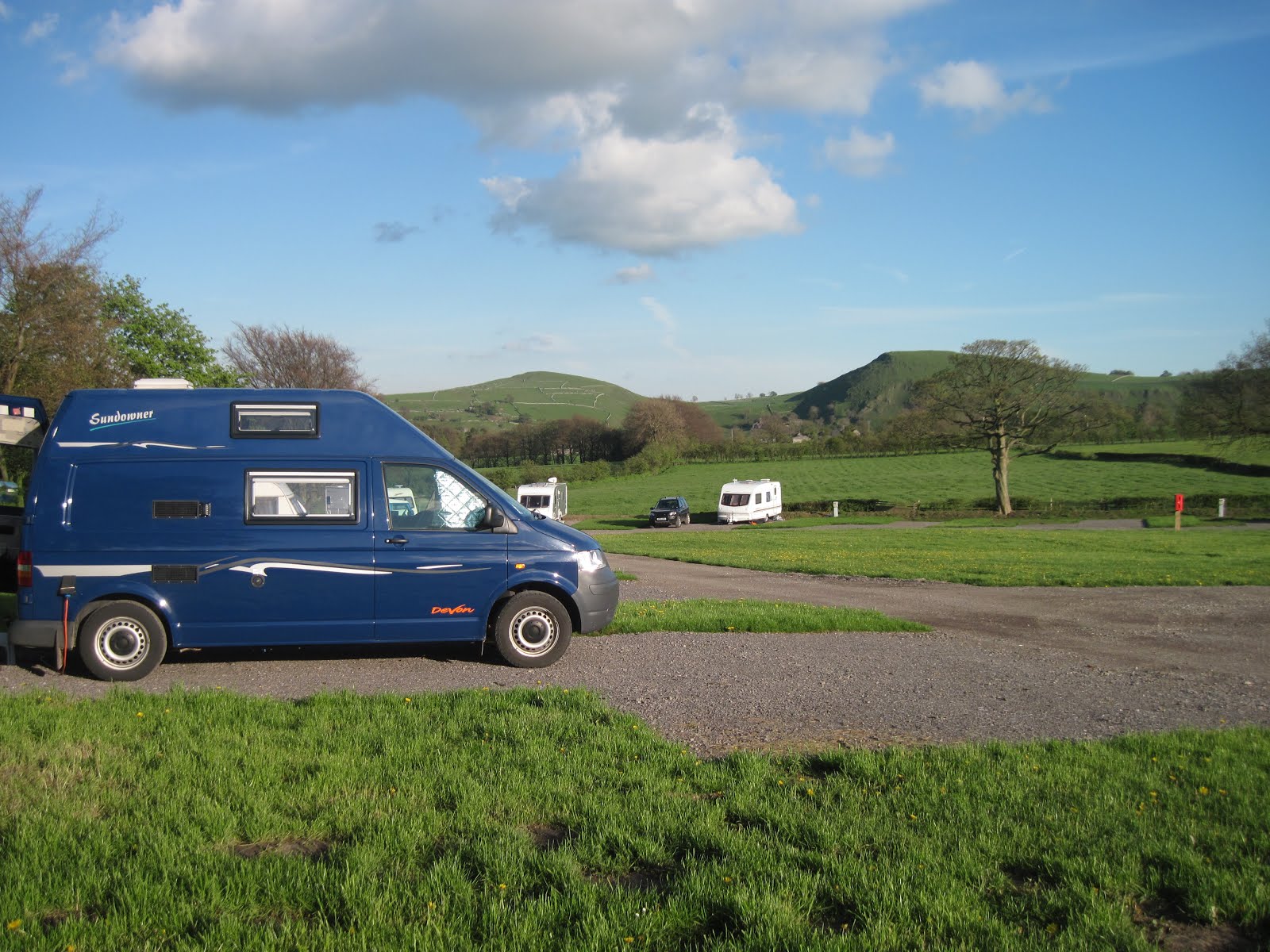
Today we will make our last trip in our Devon Sundowner, as we drive to Todds, our nearest Devon dealer, to trade our wonderful van in for a new Devon Tempest.

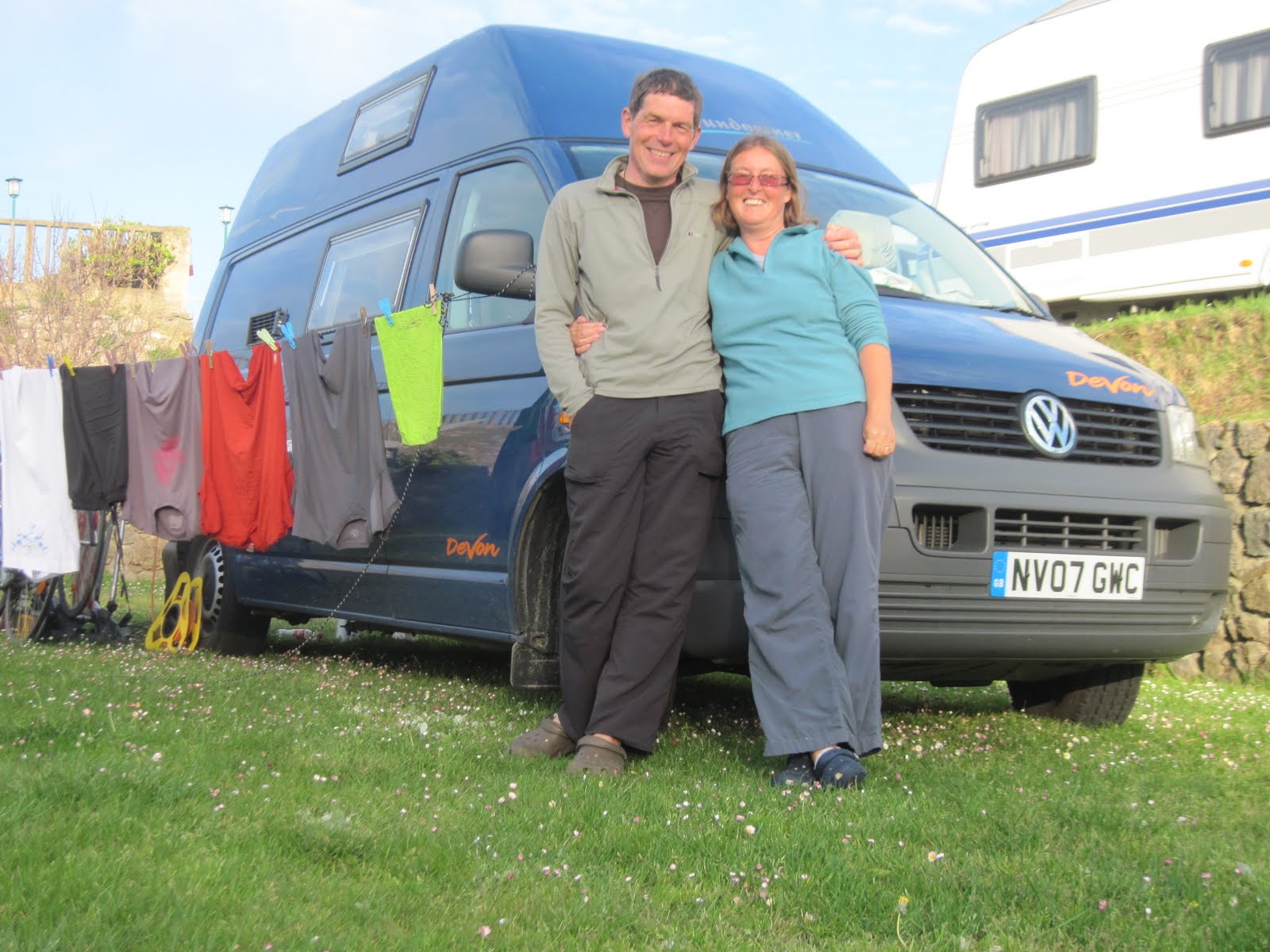
We bought our Devon Sundowner in May 2007.  In the seven years and nine months that we have owned it we have driven 71,800 miles.  We have slept in the van for 679 nights on 322 campsites across Europe.  We had only owned the van one-week when we set off for a four-week trip to Poland.  In 2009 and 2010 we spent twelve-months living in our Blue Bus and travelled through France, Italy, Slovenia, Austria, Italy again, southern France, Spain and Portugal, returning to the UK on the ferry from northern Spain. Two years ago we took the van as far east as the Hungary, Slovakia and Ukraine border.

We have loved owning a Volkswagen T5 and it has proved very reliable.  The only mechanical problem we really had was in the very south of Italy when a light appeared on the dashboard and wouldn't go away.  We found a VW garage and with a combination of poor Italian, a few English words and lots of gestures, we got the message across and they checked out the van and told us to come back in two day's time.  We had no idea what to expect and could only do as instructed.  We returned first thing on a hot and sunny day and pottered around the town while they fitted a new part to the catalytic converter.  Computer records informed them that the van was still under warranty and so there was no charge and we left pleased that VW had such a fantastic network of service centres.

In our ownership, the van has averaged about 32 mpg. It needed a new exhaust last year and, not surprisingly, we have worn out tyres.

In our opinion, the Devon Sundowner is a fantastic van conversion and the best there is on a T5. The piles of 'stuff' taking up so much space in our small flat at the moment are testament to the amount of storage space Devon fit in to the van.  The overcab space is huge and fitted chairs, bedding and other odds and ends.  At the back it has a 'secret' cupboard behind the toilet that feels almost bottomless: here we kept those things you don't need every day, the heavy duty jump leads, the tow rope, spare oil and even a spare kettle.

We have had so many special and fun times in the van but we know it is time to make the change, so this is our last post for our Devon Sundowner, the Blue Bus.  We hope whoever buys our van has just as much enjoyment from it.

Our travels in our new campervan are documented at Back On The Road Again Blog

Saturday, 28 September 2013

Where do you put everything?

We are often being asked how we manage to fit everything in to the Blue Bus, so I thought it was time to put together a post with some of the space saving ideas we have had over the years and some of the ways we have made the most of the space in the van.

Modifications to cupboards

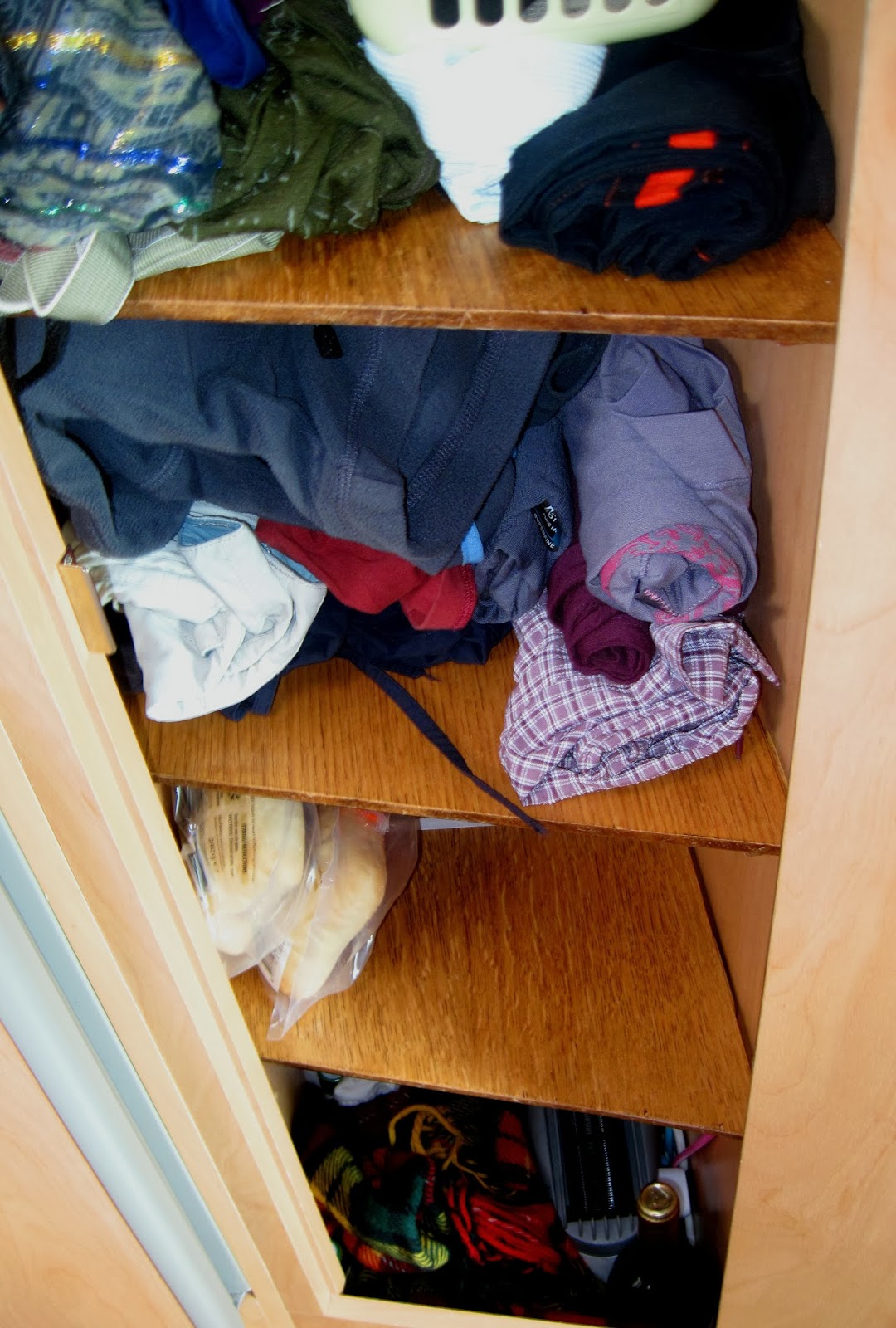
  • Added three shelves to the wardrobe which still leave a large space at the bottom where we can fit the portable fan heater and bottles of wine
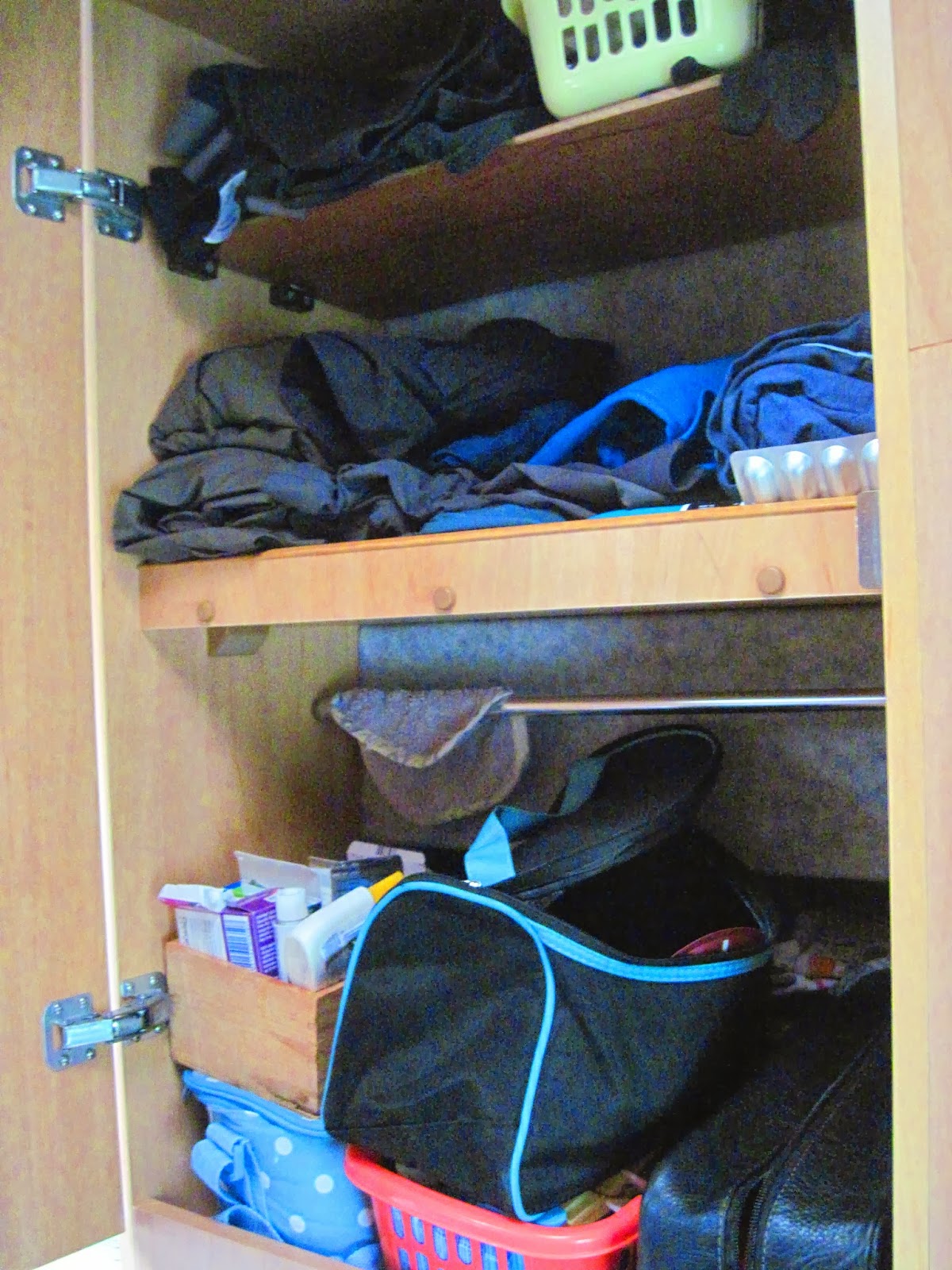
  • Added a shelf to the top half of the large cupboard above the fridge where we keep clothes
  • Added a shelf and partition to the cupboard under the cooker for food, towels and teapot, kettle etc.
  • We also use plastic baskets and boxes to keep items separate and organised


The wardrobe
Cupboard above the fridge
Cupboard under the cooker


Making best use of the space we have

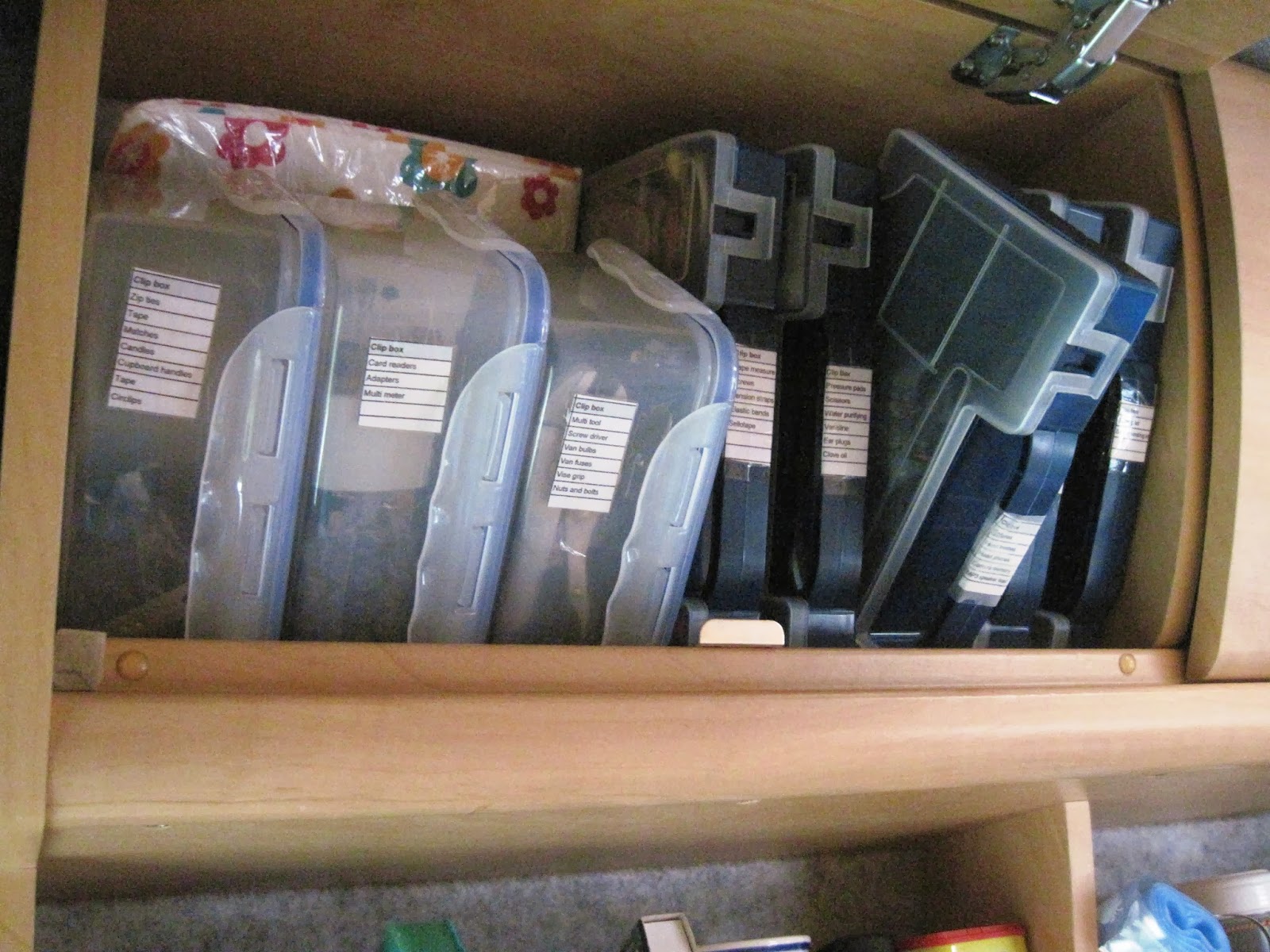
  • Fishing tackle boxes for small items and tupperware boxes all labelled (because we are always forgetting what is in them) for one of the high cupboards
  • Ikea tins for food and above these spare tea bags in a laundry net held in place with hooks
  • Travel size games in the narrow shelves in the high top

Fishing tackle boxes and tupperware clip boxes are
labelled so we remember what is in them
The net holds the boxes of tea bags
so they don't fall on to my head


Scrabble, back gammon, cards,
cribbage & dominoes


Other additions

  • Specially made carriers for our Crocs, handily placed at the back door and made from Wilkinsons car plastic waste bins and a piece of wood.
  • Nets on the front of the over cab cupboard door
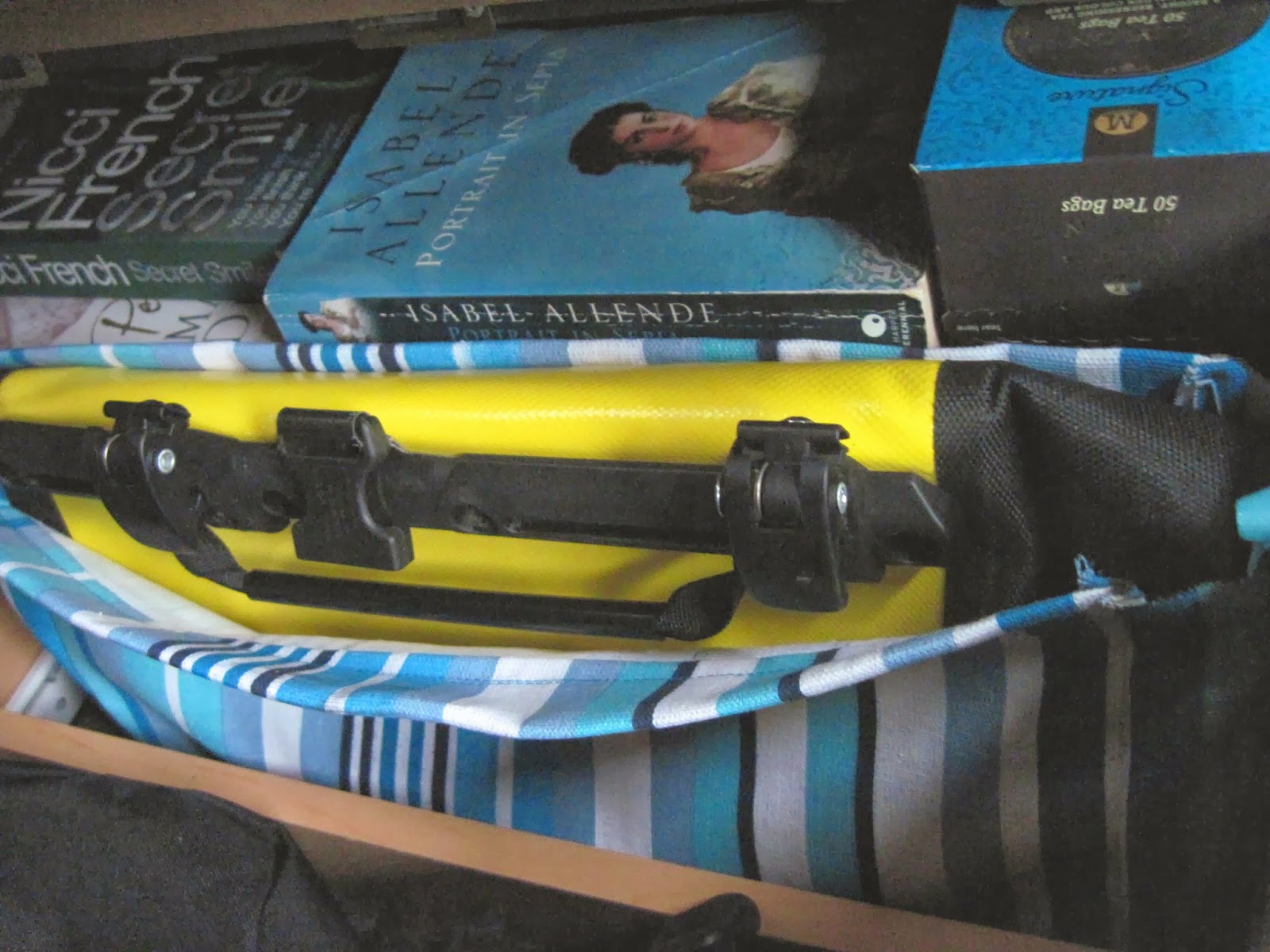
  • Under the off-side passenger seat, books and more spare tea bags fit on top of the heater and a specially made bag hooks in the narrow gap between this and the back of the under seat drawer to fit a bicycle pannier.

Our Crocs are always handy
The bike pannier fits neatly under the
passenger seat


How do you fit everything in your van?

Thursday, 23 May 2013

2013 Holiday spending

Weimar
As usual, we give readers a breakdown of our holiday spending.  This was a cheaper holiday than last year, as Italy tends to be more expensive and some of the countries we visited were much cheaper for food and cafes, although we didn't notice much difference with camp sites; in Hungary these were between €12 - €20 equivalent.


Total spending in Euros over 26 nights (2 nights on the ferry):

Diesel €542
Supermarket shopping €575
Cafes €221
Campsite €398
Other €72
Total €1808 - €69.50/day


Equivalent in sterling
Total spending £1540
Ferry Hull - Zeebrugge return with dinner £430
Total cost of the holiday £1970

Sunday, 7 April 2013

Winter Camping Tips

During the winter of 2012 - 2013 we have made a conscious effort to continue with our camping trips as often as possible.   Winter camping in a small van has some challenges and it is clear is not something everyone does.  We have been pleased that a number of people have been in touch through our contact button asking for advice on winter camping, so we thought we would put some of our top tips on the blog.


Snug as a bug in a rug
We have found that a night-time combination of sleeping bags and duvets works to keep us warm in bed even in temperatures below freezing.  We use Snugpak sleeping bags that pack up small.  If it really cold, we also always have spare blankets and have used these in the side-door foot well to cut down drafts.  We have never left the heating on all night.

Concerns about water
Our fresh water tank is under the van and is not insulated or heated.  We always check the forecast and take no risks; if the forecast is for a frost, we don't fill the water tank and instead use a 10 litre water tank in the van.  This does mean we don't have running water and a flushing toilet but it is better than burst pipes.  The down-side of this is constant filling, when we think the frosts have finally finished and then draining when we see the forecast of more frosts.
In Cardigan in March, the forecast was for above freezing and so we filled up the fresh water tank.  However, we woke up to a very heavy frost, with ice on the inside of the van windows.  I leapt out of bed to check the tap, the water was sluggish, indicating they pipes had frozen slightly but no leaks have appeared, so we seem to have got away with it.
We also never use the waste water tank when it is freezing.

Light my fire
During winter we prefer to have a hook-up, we then use a 2kw fan heater which quickly warms up the small space in our van.  When we don't have a hook-up, our diesel heating keeps the van very warm, although it does sound like we are on a count-down to launch to the moon.  Having the two heaters means we feel confident that we will always be warm.

The sky at night
Living in Greater Manchester, the light pollution means we don't get much chance for star-gazing at home and one of the marvellous things about winter camping is being able to see the stars from a dark camp site.  We use the Google Sky Map to check what we can see; it can be downloaded to your mobile phone at no cost and is lots of fun to use.


Monday, 17 December 2012

I don't stay nowhere long


2012 has been a good camper van year; we have used the van for 59 over night stays on 36 different camp sites; many of these for weekends long and short from February until December, in various parts of the country, from Whitby to London.

During the summer we are strict with ourselves and make sure we go camping every other weekend, whatever the weather and however exhausted we are from work, occasionally we have been blessed with sunshine and always we have been glad we made the effort to go.

The van is only now starting to show some signs of wear and tear after 537 nights sleeping in it over the past five and a half years and we are bracing ourselves for the cost of new upholstery and flooring in 2013; other than this, it is bearing up to our usage very well and we are very pleased with the Blue Bus.  You might have seen our article in Motorhome Monthly Magazine (Summer 2012), Living with a Devon Sundowner, which tells of our experiences of living in the van.


Highlights from our weekends away in 2012 include:

The seals at Donna Nook
Camping with friends

Three Pigeons in Graigfechan
Cliff-side camping in Whitby
Winter sun in Norfolk
Howgill Lodge site Wharfe Dale


Friday, 27 August 2010

Holiday spending August 2010


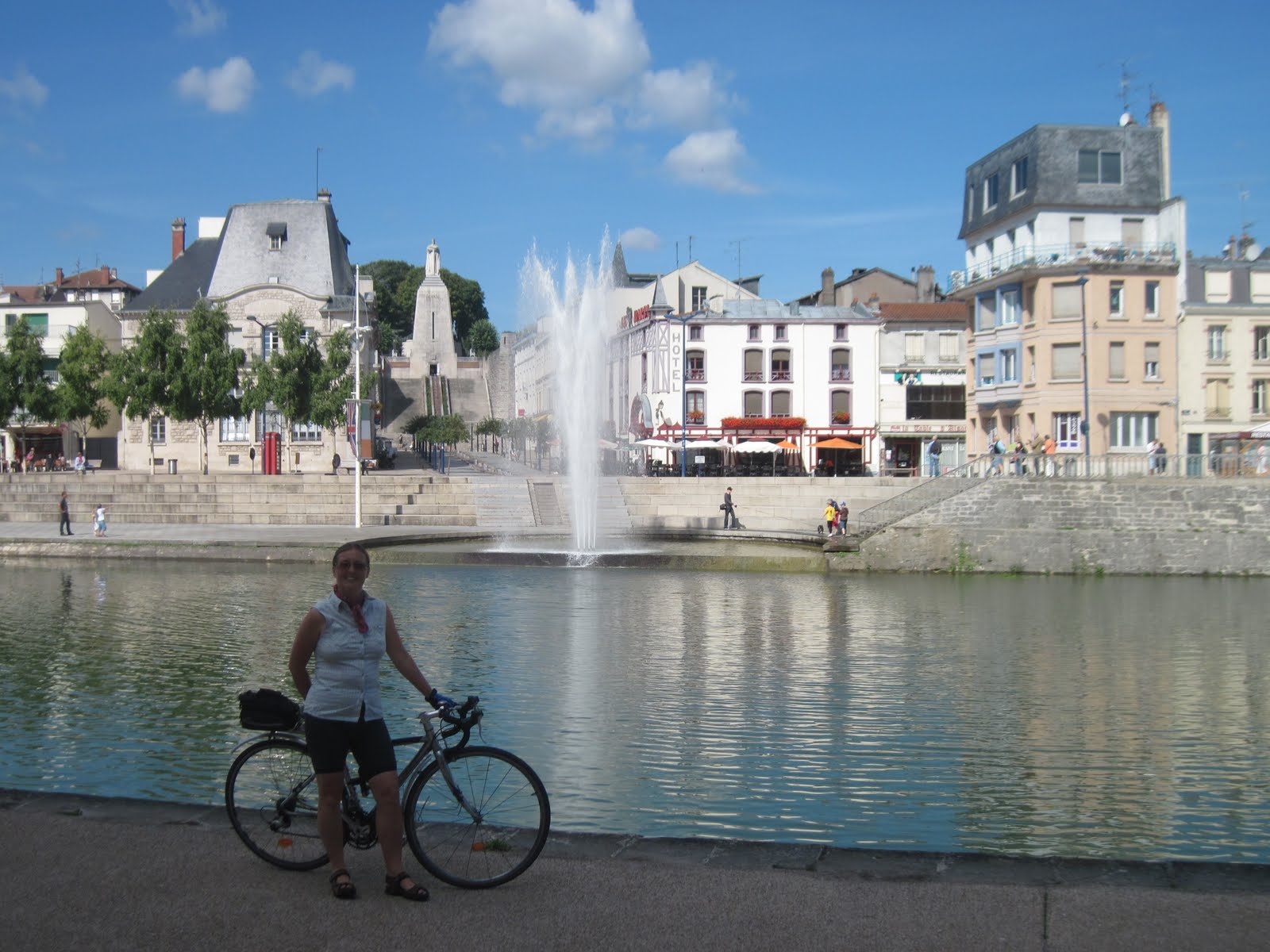
The photograph shows the pretty town of Verdun.

Spending for the 18 nights holiday in Euros:

Campsites 364
Diesel 232
Food 290
Cafes and restaurants 211
Everything else 222
TOTAL 1319 Euros


The return ferry from Hull to Zeebrugge was £582, including breakfast and evening meals.

The exchange rate was around Euro 1.2 to the £1.

Wednesday, 31 March 2010

There's so many places I want to see

This is the last post on our blog and so we would like to take this opportunity to thank a few people.

We have enjoyed keeping the blog and we are sure we will refer to it in the future. We are very grateful to everyone who has visited the blog over the past 12 months, almost 6,000 hits in four months is impressive and helps us feel in contact with other people. As well as old friends, we have made new contacts via our blog and now have a list of other travellers blog’s to follow from Salford with envy.

We really appreciate the time taken by everyone who has emailed us over the past 12 months or got in touch via the blog. We have always enjoyed hearing your news and have tried to reply to all of you.

Although the ideas on the blog come from both of us, it is Carol who puts the words together. Anthony took on the duty of finding song lyrics for the post; not always an easy task when faced with a post about an obscure topic such as dinosaur footprints or the umpteenth post about walking or cycling; he rose to the challenge and has enjoyed being creative. We hope you have managed to guess some of the lyrics and enjoyed looking up the ones you don’t know on the list of answers.

Last, but by no means least, we want to thank Matthew and Rachel. Without their help and support the trip would have been much more problematic; they gave a home to our elderly and blind cat, posted us books and essential equipment, used up most of their holidays coming to visit us, looked after the flat and opened our small paper mountain of mail and purchased various concert tickets for us to help make our return something we can look forward to.

You may be wondering, how we are feeling as the trip comes to an end. The post title says it all really; the trip has given us a sense of what Europe is, how we fit in to it and how much more of it there is to explore. Most importantly, the trip has made us realise how much fun we get from living together in the van, hitting the road and exploring new places; we will certainly miss being as free as a bird (no apologies for using this lyric twice)

Wednesday, 22 April 2009

Camp site overview

We have stayed on 123 different camp sites during the trip, from the fantastic to the dreadful.
This link will take you to a fun article I had published in Motorhome Monthly Magazine about the variety of shower facilities on campsites.
The overnight charges by camp sites vary widely and do not always relate to the facilities they provide. However, for those of you planning a similar trip the following information may be of interest to you.
The range of prices
The cheapest camp site we stayed on was the Municipal site in Tomar, Portugal that was 4.53 Euro per night for a site with hot showers and good, clean facilities. The most expensive was in Ptuy in Slovenia at 36 Euro per night; this price included unlimited access to the swimming pool complex of 10 pools, indoor and out.
More details about each campsite are in posts for each country.
Broken down by country, overnight charges on camp sites have been within the following ranges:
France
Cheapest – camping St James les Pins, Guillestre at 11 Euro per night, a lovely site and very good value
Most expensive – Camping Chantecler, Aix en Provence at 23 Euro per night
Italy
Cheapest – Corigliano at 9.50 Euro for a stay of more than three nights (this was cheap because not all facilities were open in May).
Most expensive – Camping Piccolo Paradiso in Sasso Marconi at 29.50 Euro per night, this was an incredibly over-priced site.
Austria
Cheapest – Camping Wieshof, St Johann im Pongau, 22 Euro per night with electricity and one of our favourite sites
Most expensive – Camping Stigger, near Innsbruck, charging 32.80 Euro a night for a cramped space with poor facilities and best avoided
Slovenia
Cheapest – Natura Campground in Podcetrtek at 18 Euro per night in high season, without access to the aqua park and very good facilities
Most expensive – Terme Ptuj, Ptuj charging 36 Euro per night in the high season, but this includes access to a huge swimming pool complex
Spain
Please note that staying on a site in Spain during the winter months for longer periods can give you very good savings. We did not stay anywhere long enough to qualify for such savings.
Cheapest – Camping Sierra Espuna, El Berro at 13 Euro per night, a beautifully positioned site with reasonable facilities
Most expensive – Camping Marjal, Guardamar at 30 Euro per night in November is expensive although the facilities are very good
Portugal
Cheapest - Parque Municipal in Tomar is unbeatable value at 4.53 Euro per night in the winter and only double that in summer
Most expensive – Vale Paraiso Camping in Nazare at 18 Euro per night, expensive for fairly average facilities

Tuesday, 21 April 2009

Bicycles and kettles advice

We certainly don't claim to know everything, but thought we would share things we have learnt. However, please remember, what works for us may not work for you.

Bicycle spares and tools
We don't have very much room in the van for carrying lots of stuff and bicycle tools was one of the things we rationalised down to the bare minimum. Having spent money on a poor quality bike repair because we had not bought the tools required, we ended up buying the tools and doing the repair ourselves; it would certainly have been cheaper if we had bought the tools with us and we will re-think what we take for future trips.

Kettle de-scaling
Living in the north of England this has never been much of a problem for us. However, the kettle has needed de-scaling regularly all over Europe. Generally it is difficult to get hold of the chemical de-scalers, as mainland Europeans don't use kettles very often, so in future we might bring this with us. Wine Vinegar is widely available and this works well too, boiled up with some water and left to soak, although the van will smell as if you are pickling onions!


Technical IT related stuff

Some technical tips

Wi fi on camp sites
Sometimes it is worth paying for 7 days wi fi when you are only staying on a site for 3 or 4 days, as this can work out better value. It is then worth hanging on to passwords etc until the 7 days are up, as the next site may use the same Internet Service Provider and you may be able to sign on to the internet without paying any extra.

Back up photographs / documents etc
We upload photographs on to the laptop from the camera and have a pen drive and an external hard drive for back up. The external hard drive is kept in the van, but the pen drive comes out with us. Whenever we get the chance we also upload photographs to Facebook and our blog. Hopefully this way we won't lose the photographs.

TV card
We bought a Hauppauge WinTV USB adapter to use with the laptop and a small, cheap analogue aerial from Maplins, which also picks up digital TV. This set up has allowed us to watch TV occasionally; we have mainly used it to watch Grand Prix races in different countries, with varied success and have occasionally picked up BBC World. This set up will not pick up British TV and at a new location scanning for stations can take 15 minutes.

Motorhome Facts
For a small annual fee you can get loads of useful advice from fellow Motorhomers on this marvellous website, well worth subscribing to and lots of fun.

Blog counter
We only thought about adding a counter to our blog after eight months away. A counter can be found, at no cost; google blog counter, hit counter or stat counter for any number of possibilities.

Blog
We used Google's Blogger for this blog and it seems to have worked well enough. You can choose the layout you wish and it is easy to use. This is a good way to keep those back home informed about your travels and works as a journal for the trip and an additional back-up for photographs. It can be a good idea for this to one person's responsibility, to ensure continuity in the style of the blog.


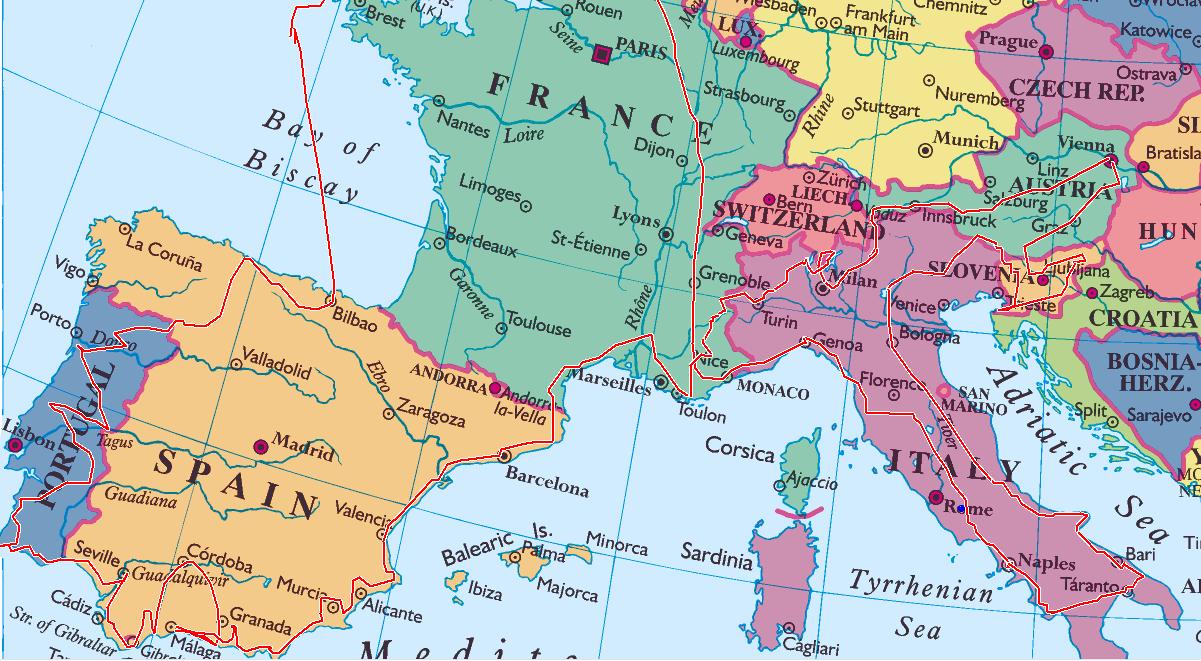
Our route

Double click on the map to see a larger version. The map shows a rough sketch of the route we followed.
To follow the red line of the route, we first drove south through France and in to Italy. More detail can be found in the list of camp sites and the blog posts.

How much did we spend?

We have monitored all our spending during the past 12 months to enable us to budget. We used a notebook for daily spending, transferring this in to an Excel spreadsheet each week under different headings.

Of course, our spending priorities will be different from anyone else. Also, the time of year we have visited a country affects the cost and the length of time you are away from home. However, taking these matters into account the amount we spent is a useful guide for others planning a trip. You may wish to take the following in to account:
  • We ate out about once a month, but visited a cafe most days, for coffee, maybe cakes, maybe lunch
  • We rented houses for four weeks of our trip - 1 week in Italy, 2.5 weeks in Spain and 0.5 weeks in Portugal
  • We replaced front and back tyres on the van while we were away and had to pay £100 for the damaged window on the van
  • We always use camp sites
  • We travelled approximately 13,000 miles over the 12 months

Our total spending for the trip was 21,650 Euro or £19,900; the rate of exchange over the year has varied from around 1.06 to 1.20, we've averaged this out to 1.1 Euros to the £.

This breaks down in to the following categories (all prices are in euros and some costs have been rounded up or down):
Campsites - Total spending 6,200 and average spending each week 124 Euro
Supermarket and food shopping - Total spending 4,900 and average spending each week 100 Euro
Diesel - Total spending 1,900 and average spending each week 36 Euro
Cafes, restaurants, icecreams - Total spending 3,350 and average spending each week 67 Euro
Maps, clothing and equipment (including tyres) - Total spending 2,400 and average spending each week 44 Euro
Entrance fees and cable cars - Total spending 1,050 and average spending each week 21 Euro
Public transport - Total spending 722 and average spending each week 15 Euro
Internet access - Total spending 820 and average spending each week 5 Euro
Laundry - Total spending 225 Euro
Tolls, vignettes and parking - Total spending 150 Euro
Stamps, telephone cards and postcards - Total spending 139 Euro
Miscellaneous - Total spending 880

There is some variety regarding how much we spent in each country we visited and we have carried out some analysis of this spending.

Average spending by country

Italy
Average weekly spending 421 Euro per week. Italy seemed to be cheap for supermarket and food spending, we averaged 88 Euro per week on this category while we were there.

Slovenia
Average weekly spending 458 Euro per week. We spent an average of 177 Euro per week on camp sites here - it was July. We spent nothing on wi-fi in Slovenia, it was either free or not available.

Austria
Average weekly spending 469 Euro per week. Coffee in cafes was expensive in Austria and we had to reduce our visits. However, we still spent an average of 66 Euro per week in this category while we were there. 78 Euro of our public transport spending was spent in the four weeks we were in Austria. Austria is a beautiful and wealthy country and the cost of living is high.

France
Average weekly spending 383 Euro per week. Campsite spending in France averaged 120 Euro per week. Supermarket and food spending was higher in France at an average of 105 Euro per week.

Spain
Average weekly spending 398 Euro per week. Our average spending on wi-fi in Spain was 8 Euro per week. Other costs in Spain were fairly average.

Portugal
Average weekly spending 357 Euro per week; Portugal was the cheapest country for us. 28 Euro was spent on internet access during the 6 weeks we were in Portugal. Campsites were cheapest in Portugal at an average of 101 Euro per week. Supermarkets and food was more expensive in Portugal than you might expect, at an average of 103 Euro per week.

Housing and other costs
In addition, we had a flat in England we continued to run and there were costs associated with this, as well as insurance for the van and additional health insurance for ourselves.

Trivial, but useful tips for anyone planning their own trip

Some trivial and useful tips for any holiday in a campervan

Haircuts - after a few months it becomes necessary to get your hair cut, this can be difficult in other languages. Anthony takes a passport photo of himself taken just after a previous cut, he shows this to a hairdresser and ask for a cut that is the same.

Take a dressing gown - we felt this was something we didn't want to make space for, but soon bought one. Useful at camp sites where showers are too cramped to get dressed, for keeping warm while making the morning cup of tea and for wearing on the way to the swimming pool.

Visit a weigh bridge - load up and check what capacity, if any you have before you set off.

A journal - this helps us to remember where we have been and provides us with an opportunity to reflect on good and bad experiences.

Use skype - this is a fantastic way to phone home. We would usually pay for some internet access on a camp site, so being able to ring home at the same time is a bonus.

Silk sleeping bags - these were expensive, but an excellent investment. In very hot weather they are lovely to sleep in, keeping you warm enough at the coolest part of the night. In very cold weather they are a warm, extra layer with the duvet. They weigh very little and take up minimal space.

Mosquito nets - something to stop small creatures flying in on hot days is useful. We use muslin sheets hung over the doors, some vans have these built in, otherwise it is worth rigging up something.

Electrical adapters - it is worth getting a UK adapter for european plugs to use in the van if you have to buy some electrical equipment while you are away, for example a new kettle. This will allow you to plug it in to the UK socket in the van, without having to change the plug.

Teabags - Somehow European teabags are only strong enough to make dishwater. Take as many as you can carry and stock up if you are passing Gibraltar.

The weather on our trip

We thought other people planning trips in southern Europe might find it useful to have some idea what weather to expect. However, it is important to remember that the weather varies from year to year and the temperatures and conditions we experienced may not be typical.

In 2009 we were on mainland Europe for 254 days. Of these:
  • 197 were sunny or fine days (80%)
  • 23 days had some rain, either a thunderstorm or a light shower
  • 34 days were dominated by rain, either constant showers or very heavy rain for most of the day (13%).
Those 34 days of rain can be analysed further, as most of our rainy days were in particular areas or at particular times:
April - as we travelled down to Italy, we had some rainy days.
Early June - we had one rainy day in Italy on the Gargano peninsular
June - we had some thunderstorms around Lake Garda
Late June - we had some rainy days in the Dolomites
July - we had some rainy days and thundery days in the Slovenian mountains
August - we had a couple of rainy days in Austria and a day or so of rain in the Aosta valley in the Italian Alps
September - it rained while we were in Provence for a few days
December - Spain experienced the wettest December for 50 years and from 18/12/09 we had seven days of rain.

We could have avoided some of these rainy days if we hadn't chosen to be in the Dolomites or the Alps. However, we also had lots of fantastic weather in those places.

Other thoughts on the weather in 2009:
May - a lovely month to be in Italy
June - temperatures reached over 30C in Italy by mid June
October - the south of France became quite cold and it was noticeably warmer as soon as we travelled in to Spain
November - from what others told us the weather was unusually hot for this time of year in Spain. We were still wearing shorts and temperatures were over 20C.
December - until the rain started, the weather in southern Spain was around 17C and fine.

2010
January - We had six days where it mostly rained and six days with a shower, the remaining 19 days were fine and sunny, temperatures were between 9C and 18C.
February - We had four days when it rained almost all day and ten days where we had a shower or two, but were still able to get out for a walk at some time, the remaining 14 days were fine, sunny and usually warm, around 15C. The general opinion with regulars has been that the weather is wetter than previous years.
March - We were moving gradually north. We had six days when it rained almost all day and six days when we had showers or rain some of the day. The remaining 19 days were fine, usually sunny and fairly warm, between 12 and 18C, although nights could be cold.

Generally, we feel we would prefer not to travel in our small van during the winter months again. Late spring, summer and early autumn were lovely, we could be outdoors most of the time, being active during the day, eating meals outside and enjoying the sunshine and we missed that in the winter.


Clothing

We spent many holidays in our youth backpacking and so we are used to having clothing for holidays that is easy to wear, can be hand-washed and dries quickly.

For this trip we planned the clothing we would need and purchased items over a period of 12 months. Light-weight performance clothing for walking, cycling and travel wear is often expensive and huge savings can be made by buying in sales or second-hand on Ebay; this is particularly useful for Rohan gear, which is very expensive, but if you have the time you will often find what you need on Ebay.

Our trip has given these items a long-term test and manufacturers we would recommend include:
  • Alpine Lowe - their dual fibre dryflo briefs are the most comfortable and quick drying underwear money can buy. Their dry flo tshirts are also marvellous.
  • Rohan - particularly good for trousers and shorts, light-weight fleece jumpers and shirts.
  • Karrimor - some good light-weight tshirts
  • Columbia - Anthony has one excellent tshirt of theirs, bought some time ago and never seen again!
  • Icebreaker - their merino wool tshirts are fantastic to wear and wash
  • Berghaus - tshirts and long-sleeved tops can be good
  • North Face - good quality shorts

We also took Tilley underwear, but found this did not perform as well as Alpine Lowe. The Rohan fleece jumpers are so good, the cheaper ones we also took feel like a mistake.

In the van we always use camping or travel towels, such as LifeVenture or Blacks own brand. These dry quickly and don't get damp and musty when they can't be dried outside.

Everyone's needs are different, but we packed as follows (where there are two numbers, the lower one is Anthony's clothing):
  • Shorts - 2 pairs
  • 3/4 length trousers -2 or 3 pairs
  • Trousers - 3 pairs
  • Tshirts or shirts - 8
  • Jumpers - 2 or 3
  • Long-sleeved tops - 1 or 4 (Anthony does not feel the cold!)
  • Nightwear - 2 sets
  • Shoes - 2 or 3 pairs of sandals, 1 pair walking shoes, 1 pair of outdoor shoes and 1 pair of Crocs each
We also packed cycling shorts and swimming costumes.


Literary matters


Novels

It was not possible for us to take enough books to read during a whole year. However, this was not a problem, as we were often able to swop books with other travellers and this was an excellent opening line with new friends. Some campsites in Spain in particular, have books in English you can take away. We swopped books and DVDs with Mike and Theresa each time we met up with them - this is the excuse for putting their photograph here.

We have tried to read some books that provide some background to the countries we have travelled in. Below is a list of some of the ones we found most informative.

Books about Europe generally:

  • Europe in a Motorhome, HD Jackson – covers southern Europe and useful motohoming information
  • In Europe: Travels through the 20th Century, Geert Mak – fantastic book with so much information
  • Journey through Europe, John Hillaby – a walk from northern to southern Europe about 30 years ago
  • A Little History of the World, EH Gombrich – excellent background to European history

Books about particular countries:

  • The Dark Heart of Italy, Tobias Jones – good background for contemporary Italy
  • Pompeii, Robert Harris – good historical and geographical background for the Bay of Naples
  • A Farewell to Arms, Ernest Hemingway – set in Slovenia and Italy in the first world war
  • Ghosts of Spain, Giles Tremlett – good background for contemporary Spain
  • Soldiers of Salami, Javier Cercas – A well put together story fluctuating between the present day and the Spanish civil war
  • Driving over lemons, Chris Stewart – an ex-pat emigrating and farming near Orgiva
  • A Moment of War, Laurie Lee – A well written account of his time in the Spanish civil war (George Orwell's book is also fantastic, if you are interested in this period)
  • Zorro, Isabel Allende - an excellent tale and good background to Spanish colonialism in north America
In addition, we have Rough Guides or Lonely Planet guides to each country we have travelled in, depending on what has been available in the charity shop or shops when we arrive in the country, we don't really have a preference.

Walking and cycling guides

In Austria and Italy (usually) it was possible to buy local walking maps, which is our preferred way to plan days out walking. However, in Spain and Portugal we have not been able to find suitable scale maps and would advice others to buy maps from Stanfords, via their excellent on-line shop, before setting off.
The following guides have been useful:
  • Walking in The Algarve, Julie Statham, a Cicerone Guide - 34 walks on the coast and in the countryside around The Algarve.
  • Walking in Adalucia, Guy Hunter-Watts - walks in Natural Parks in Andalucia. We used this in Aracena and around Ronda and found it very useful.
  • Cycling Southern France, Loire to Mediterranean, Richard Peace - information and routes for cyclists.
  • Slovenia (Landscapes), David Robertson and Sarah Stewart - Very useful book for walks in Slovenia and includes some driving tours and picnic ideas.
Languages

For the countries we were sure we were visiting we took a dictionary and phrase book. Otherwise, the Berlitz European Phrase book is a permanent part of the kit in our van; ours covers 12 languages and means we will never find ourselves in the Netherlands not even knowing how to say thank you again.


The size of your campervan


We like having a small campervan and certainly in summer it is more than adequate for our camping needs. We spend a lot of time out of doors and use the van for cooking and sleeping.

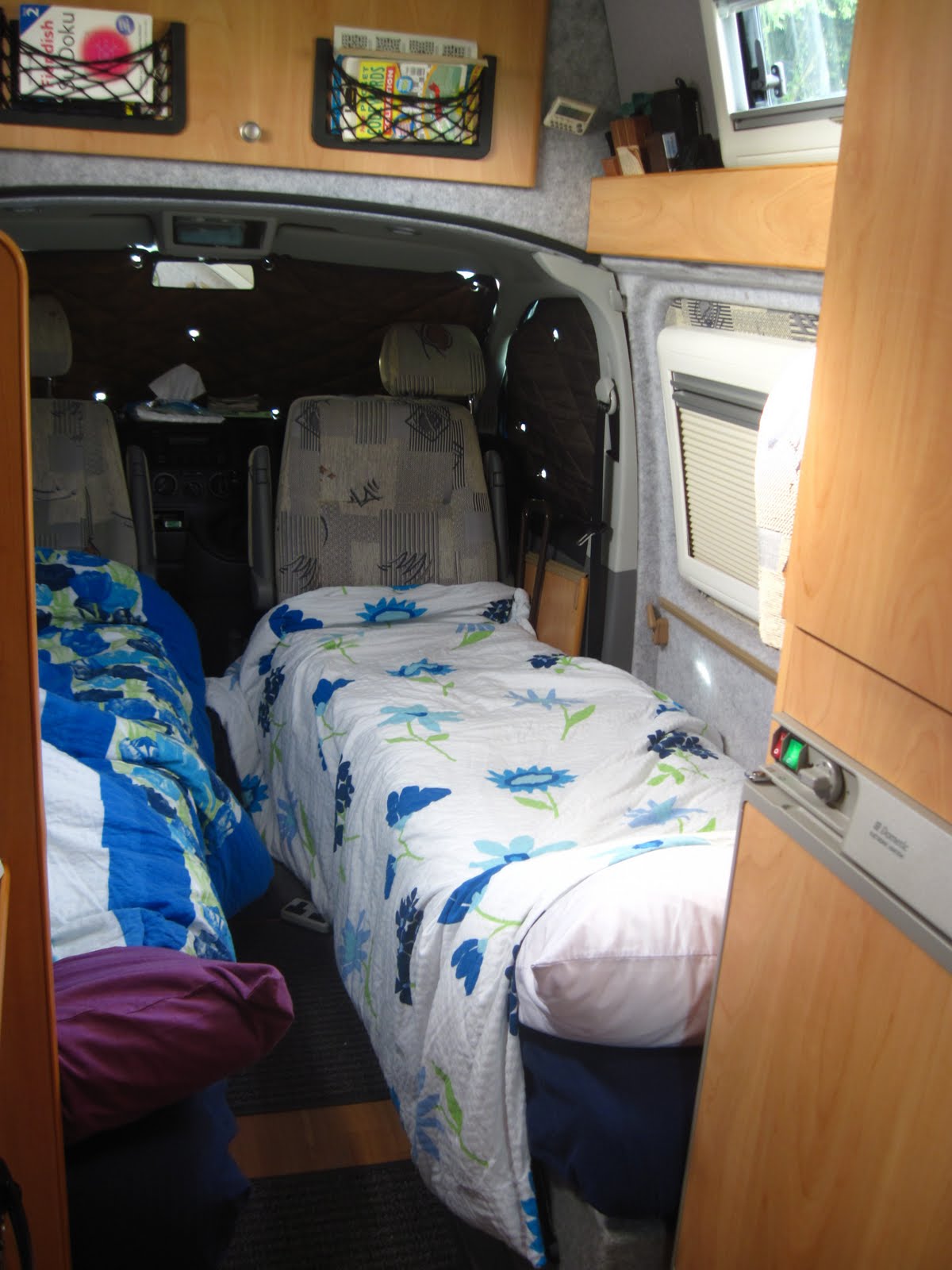
Some vans have fixed beds to save the work of making up a bed every night. In summer, the design of the Sundowner means that we can leave the beds made up every day if we are eating out doors, we just put the sheets and duvets away. This gives us two couches which are excellent for lounging on, using the front seats that are turned round to lean against.

On our big trip we have been able to eat breakfast outdoors up until December in Spain; there have been some mornings when it has been too cold, but not too many. By December it is dark by 18.30 and we haven't eaten an evening meal outside since October in France, as we usually eat around 19.30 and it goes noticeably cooler, even in Spain, once it is dark.

Even in colder weather, the van is fantastic; the diesel heater soon warms up the small space and we are lovely and snug. The problem is not the van, but the campsite facilities. Our post for 14 December describes our experience at one campsite, but the same is true of many sites; the toilet blocks are rarely heated and often do not have exterior doors, this makes showering a drafty affair on days when it is breezy and cool and we look enviously at those vans with their own bathrooms.

The photos give you an idea of the space we have available in our Blue Bus.

This link will take you to an article that was published in Motorhome Monthly Magazine in 2012 about Living with a Devon Sundowner, if you want to know more about our van.