Monday, 9 February 2015
A fond farewell and last post to our Devon Sundowner
Our travels in our new campervan are documented at Back On The Road Again Blog
Today we will make our last trip in our Devon Sundowner, as we drive to Todds, our nearest Devon dealer, to trade our wonderful van in for a new Devon Tempest.
We bought our Devon Sundowner in May 2007. In the seven years and nine months that we have owned it we have driven 71,800 miles. We have slept in the van for 679 nights on 322 campsites across Europe. We had only owned the van one-week when we set off for a four-week trip to Poland. In 2009 and 2010 we spent twelve-months living in our Blue Bus and travelled through France, Italy, Slovenia, Austria, Italy again, southern France, Spain and Portugal, returning to the UK on the ferry from northern Spain. Two years ago we took the van as far east as the Hungary, Slovakia and Ukraine border.
We have loved owning a Volkswagen T5 and it has proved very reliable. The only mechanical problem we really had was in the very south of Italy when a light appeared on the dashboard and wouldn't go away. We found a VW garage and with a combination of poor Italian, a few English words and lots of gestures, we got the message across and they checked out the van and told us to come back in two day's time. We had no idea what to expect and could only do as instructed. We returned first thing on a hot and sunny day and pottered around the town while they fitted a new part to the catalytic converter. Computer records informed them that the van was still under warranty and so there was no charge and we left pleased that VW had such a fantastic network of service centres.
In our ownership, the van has averaged about 32 mpg. It needed a new exhaust last year and, not surprisingly, we have worn out tyres.
In our opinion, the Devon Sundowner is a fantastic van conversion and the best there is on a T5. The piles of 'stuff' taking up so much space in our small flat at the moment are testament to the amount of storage space Devon fit in to the van. The overcab space is huge and fitted chairs, bedding and other odds and ends. At the back it has a 'secret' cupboard behind the toilet that feels almost bottomless: here we kept those things you don't need every day, the heavy duty jump leads, the tow rope, spare oil and even a spare kettle.
We have had so many special and fun times in the van but we know it is time to make the change, so this is our last post for our Devon Sundowner, the Blue Bus. We hope whoever buys our van has just as much enjoyment from it.
Our travels in our new campervan are documented at Back On The Road Again Blog
Monday, 10 November 2014
Camping, camping and more camping
Although our summer holiday took up most of our holidays this year, we have managed to enjoy lots of weekend away over the past four months.
Highlights have included:
| Walking above Haweswater in the Lake District |
| Music at Upton Blues Festival |
| Looking over Morecambe Bay from the Fairy Steps in September sunshine |
| Cycling by the River Thames near Chertsey |
| The interesting Halo sculpture at Wycoller Country Park |
Tuesday, 1 July 2014
Through France to the Pyrenees Eight: Money and The Tour de France
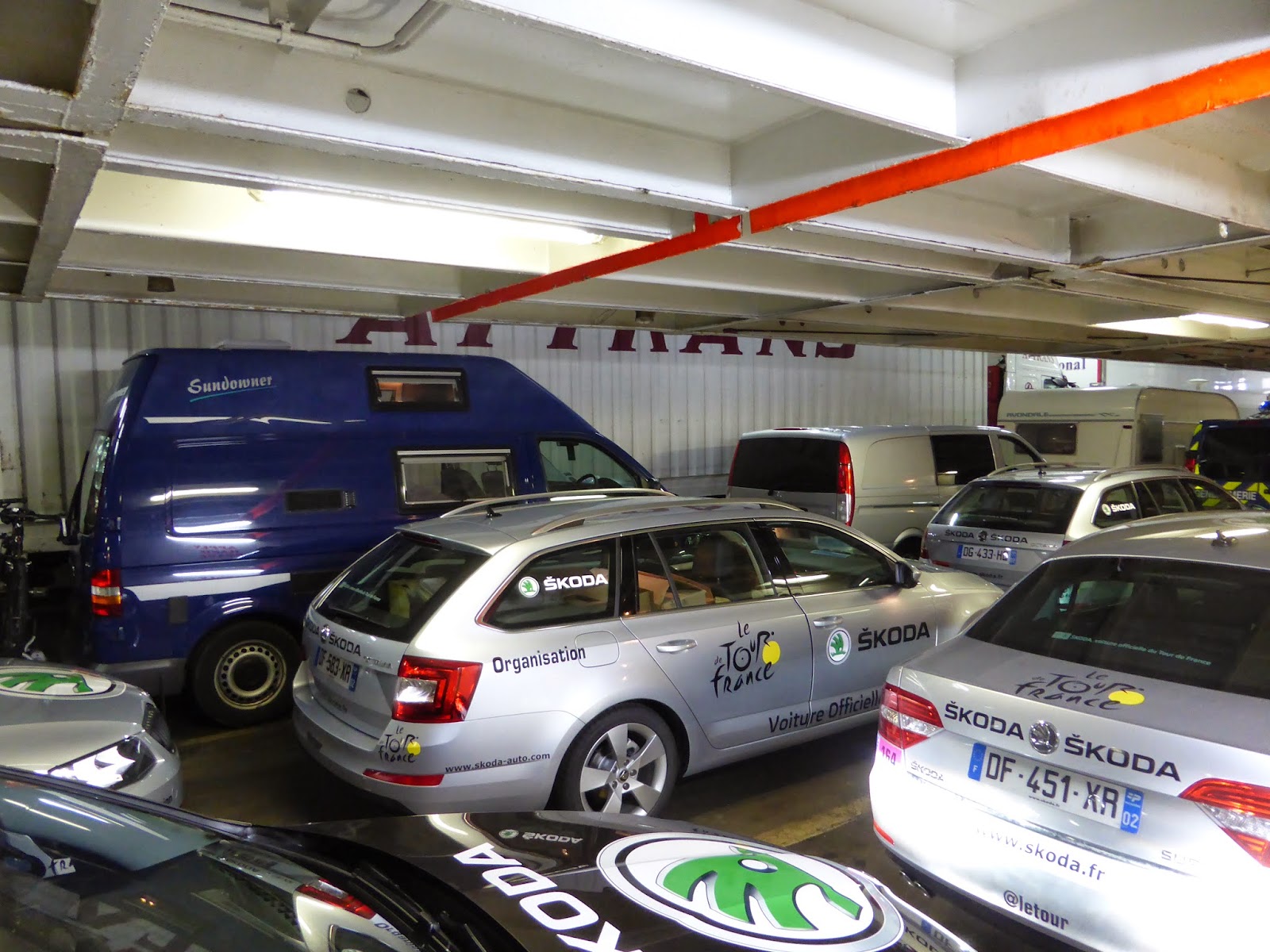
| Tour de France race cars on the P&O ferry |
The costs for this years holiday were as follows:
Diesel (2,280 miles) £302
Food & drink bought in supermarkets etc £538
Cafes and ice creams £188
Camp site fees (mostly ACSI low season rates) £286
Other bits and bobs, including motorway tolls £122
Ferry (return with evening meals) £466
Total £1902
Sunday, 29 June 2014
Through France to the Pyrenees Seven: Hand cream and unisex toilets
| The Loire River just before the storm |
The search to find Carol’s favourite hand cream took a few
thousand miles but we can report has now ended.
As some friends will know, the Olive and Almond cream by Le Petit
Marseillais is an essential part of Carol’s beauty routine and we had looked
for the distinctive pale green tins in every supermarket we visited. We thought we had an early success when we found
it in one Carrefour but all four tins they had remaining had been opened and
tried. However, Auchan in Le Mans came
up trumps and the van is now loaded up with a year’s supply.
Continuing our journey north, we spent a couple of nights at
Saumur on the Loire and were able to cycle along the river and return on the
opposite bank. The Loire cycle route is
well sign-posted and not as flat as you might expect as it often takes you away
from the river and the busier roads. We
had our lunch overlooking a small lake in a wood of tall pine trees set high
above the river that only lacked an Osprey to make us feel in Scotland. It was a splendid day’s cycling and we were
lucky to reach one of the few cafes we passed within only a minute or two of a
massive thunder storm. We remained warm
and dry with hot chocolate and ice-cream while the rain beat down on the bikes
outside and the only downside was the soggy saddles we had for the last few
kilometres.
Unisex toilet and shower facilities have been the most
common set-up on French camp sites and they make perfect practical sense,
making best use of the available facilities.
Reading some of the reviews in the camp site guide, they are clearly not
liked by everyone but really if you are not happy sharing with different sexes
then camping in France probably isn’t for you.
Gender really didn’t enter in to the equation when Anthony heard someone
using the next door cubicle to him one morning; the groans and moans the
occupant made were really uncalled for in a shared facility.
The pronunciation of French continues to cause us
difficulties, although we do our best and always try and speak some French when
we first arrive at a camp site or use a cafe or shop. While walking and cycling most people greet
us with a hearty ‘Bonjour!’ On these
encounters we have heard more different ways of pronouncing ‘Bonjour’ than
there are varieties of French wine, making us sure we will never master this language
proficiently. A French phrase that we
thought was from the world of ‘Allo ‘Allo only and had nothing to do with real
life French was ‘Oo La La!’ However,
when France beat Switzerland so resoundingly last weekend, to our delight the
French man sitting next to us uttered this wonderful phrase.
| An old farmhouse in the Eure valley |
Another valley, another Voie Verte; this time north of
Chartres in the Eure valley. We camped
at Marcilly sur Eure at a site mostly used as an overnight stop by English
vans. The Voie Verte follows the Eure
valley for about 20kms and was surprisingly pleasant cycling in this little
frequented area. The cycle route follows
an old railway line and is good tarmac and flat cycling through the Cheshire of
France. The Cafe de la Gare in
Ezy-sur-Eure is worthy of special mention in a country of cafes; it was a
charming and individual cafe run by Annie and watched over by her vicious
Yorkshire Terrier.
Tuesday, 24 June 2014
Through France to the Pyrenees Six: Cat sculptures and Bastides
| A stone cat sculpture in La Romieu |
We dragged ourselves away from the mountains and the second-to-very-few
showers and started to head reluctantly north.
We made it as far as La Romieu, a perfectly formed village that was too
pretty for even the best chocolate box.
La Romieu has a local legend about the woodman’s daughter, Angeline and
her cats that saved the village.
Angeline loved her cats; however, in 1342 a terrible famine hit the
village for many years and the locals were desperate enough to eat the local
moggies with the exception of two that Angeline was allowed to hide in the
attic. When the famine ended and the crops
again started to grow, these were quickly eaten by the rat population that had
multiplied unchecked with the lack of cats.
Fortunately, Angeline’s two cats had had kittens and these cats were
able to chase and kill the rats, thus saving the village from further
starvation. Now stone sculptures of cats
can be found on window ledges and walls, charmingly sleeping and creeping
around the village.
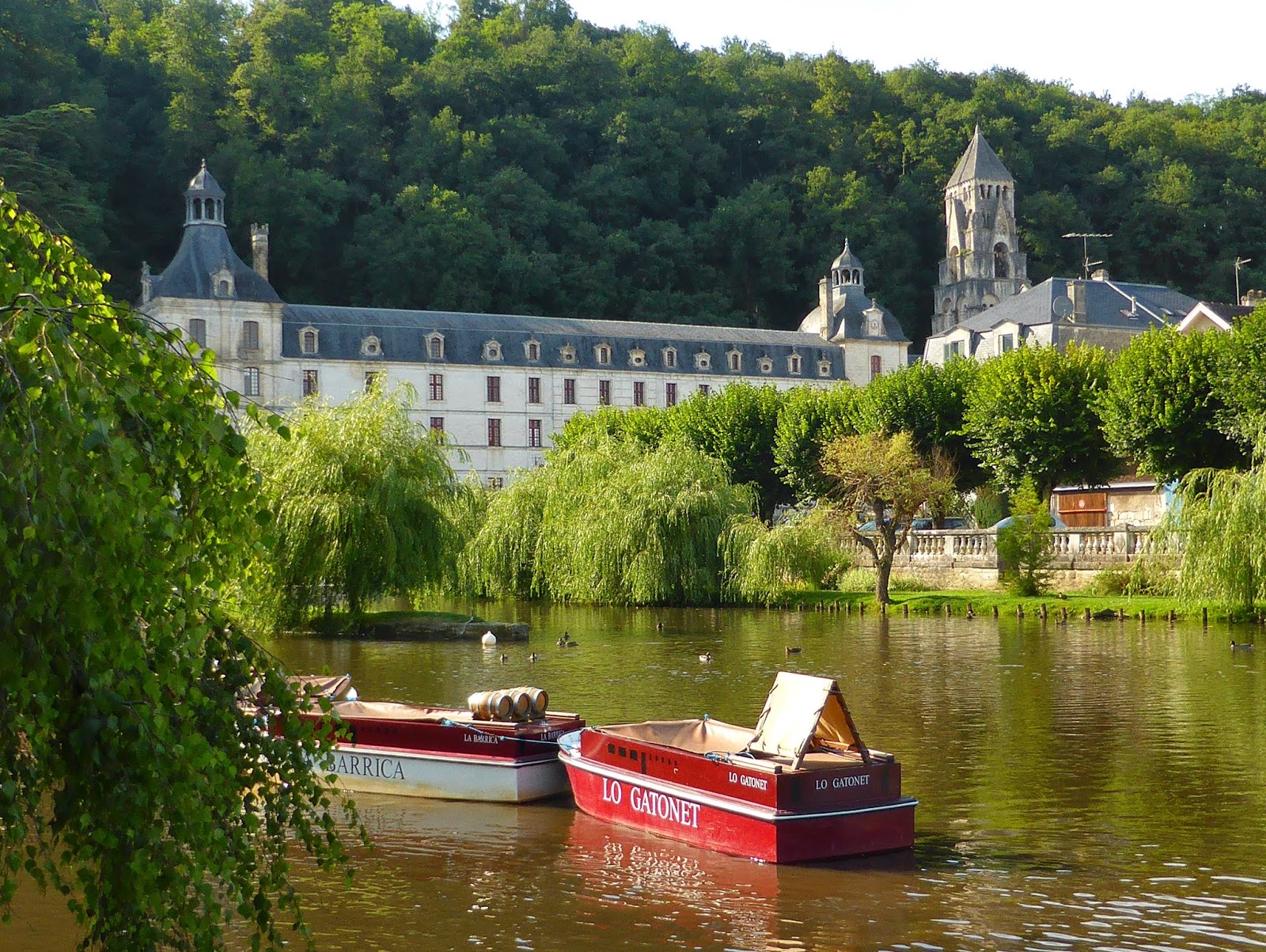
| Brantome on the river Drome |
The countryside around La Romieu is undulating and dotted
with large farmhouses and rural villas but is mostly fields of cereals and
fruit trees and woodland. We followed
one of the local way-marked walks and after meeting a couple of groups of
pilgrims on their way to Santiago Compostela near to La Romieu we didn’t meet
anyone else for over 10kms. The
Collegiate Church in La Romieu is on the pilgrim route and is a World Heritage
Site.
Heading even further north we crossed the rivers we had met
in the Massif Central; we crossed the Garonne in Agen, the Lot in the pretty
market town of Villeneuve-sur-Lot and the Dordogne in wine soaked Bergerac. We crossed Bastide country; these fortified
towns generally from around the 13th Century all originally followed
a similar design with a fortified rampart and a central square surrounded by
arcades. Some of these Bastides have
survived more complete than others.
Saturday, 21 June 2014
Through France to the Pyrenees Five: Posh Showers and Pilgrims
We tore ourselves away from the lentils and volcanoes and
made it to the Pyrenees. OsmAnd told us
our altitude as we drove past Lourdes and climbed up the mountain road to
Gavarnie. The air was cooler at around
1,300m above sea level and in the evening it was soon long-trousers and jumpers
weather; items of clothing we had banished to the back of the wardrobe since
leaving England.
| Anthony looking over to the Cirque de Gavarnie |
During the daytime it was back in to shorts in the sunshine
and we have to say that the Cirque de Gavarnie is the most spectacular natural World
Heritage Site we have seen yet. We
walked up to 1700m to an alpine meadow viewpoint above the Cirque de Gavarnie on
a less travelled route that we had to ourselves. We enjoyed our picnic with a ring-side seat
over the valley, entertained by the Alpine Choughs and the Griffon Vultures
above our heads and then we crossed fast flowing glacial streams and walked
through woodland down to the bowl of the Cirque itself. Here there is a hotel and a terrace that has
a spectacular view of the Cirque and is just the place to enjoy a beer (€8 for
two being as you ask). We took the easy
route back down to the village with the other pilgrims and resisted the
temptation to buy a fluffy whistling marmot in the gift shops.
We retreated back
down to the valley for some cycling, as the Col du Tourmalet is still not open. We chose an ACSI camp site in Argeles-Gazost
next to the Voie Verte that follows the Gave de Pau valley. We were surprised to find the camp site very
busy so early in the season and we are not sure if the attraction is the proximity
to Lourdes, the entertaining rabbits on the site or the plush shower rooms that
wouldn’t look out of place in a four star hotel. Each shower room is individually designed and
the poshest has a sink set in a boulder.
The site also has a series of swimming pools, including a circular
rapids section and swimming against the current was hard work. The camp site bar is showing the football every evening and we
watched France resoundingly beat Switzerland 5-2.
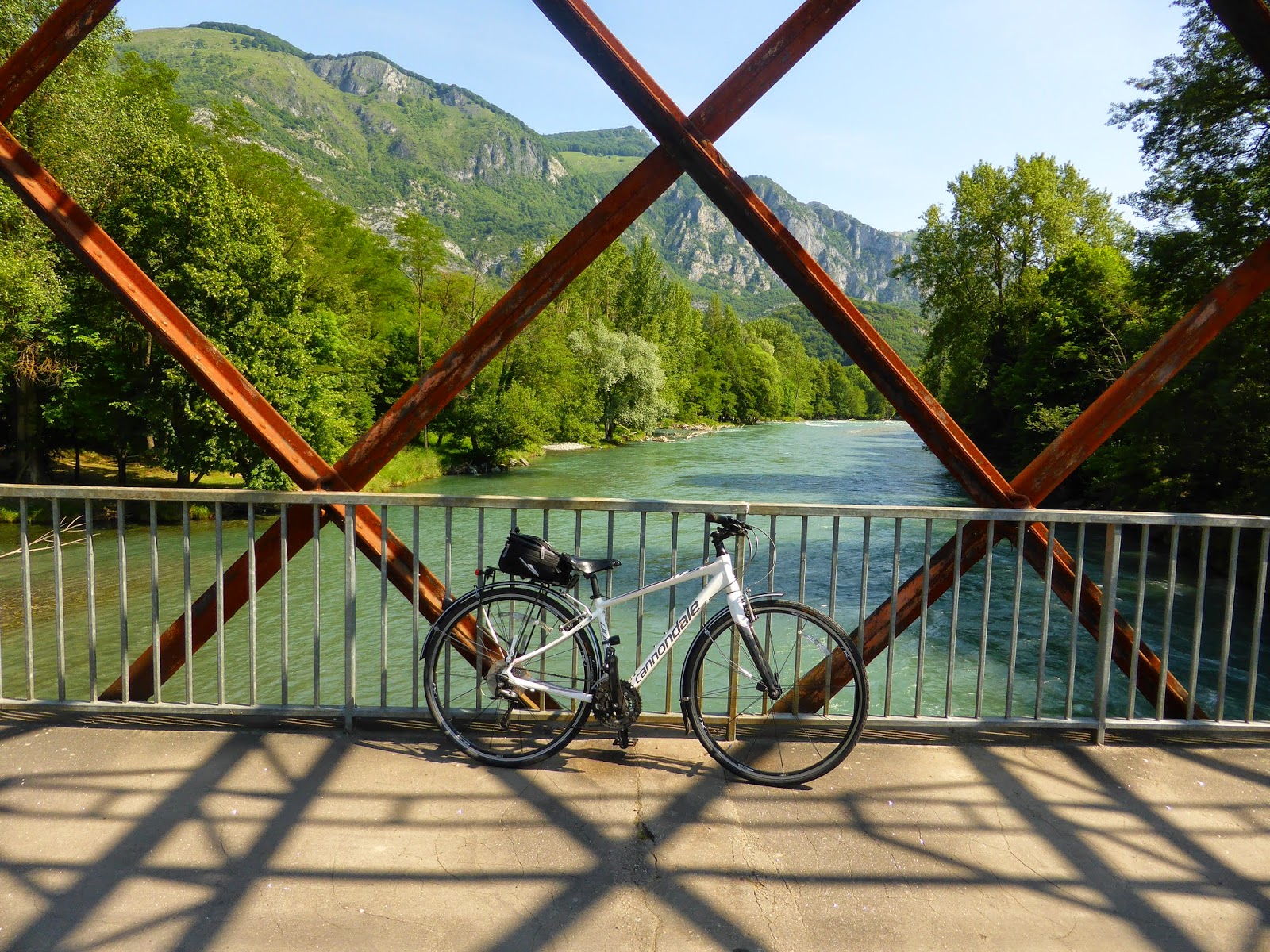
| The river Gave and cycling on the Voie Verte |
The Voie Verte cycle route we had come for follows an old
railway line through the valley and small villages to the edge of Lourdes and
most of the other cyclists we met were lycra-clad boy racers. We stopped in the village of Geu to see the
Lavoir that was prettily set by a stream at the top of a hill and spotted a
pair of Egyptian Vultures. Lourdes and
the number of people there is beyond our comprehension and all we can say is
that we enjoyed some good ice-cream and Anthony got a puncture in his back
tyre.
We took the van out to high up in the Vallee du Marcadau and
walked up the river Gave, walking past gushing waterfalls, through an abundance
of flowering Azalea bushes and in to green mountain pastures. We spotted a Dipper in the fast flowing
stream, such a small bird holding its own in such energetic water and certainly
doing some White-water dipping.
Monday, 16 June 2014
Through France to the Pyrenees Four: Brocante and relaxation
| Entraygues-sur-Truyere across the river Lot |
We stumbled upon a lovely camp site in
Entraygues-sur-Truyere thanks to the Rough Guide and ACSI. With a lack of churches in the area, the
Rough Guide was forced to mention other activities and included a passing
reference to lovely cycling along the Lot valley from Entraygues. When we found there was an ACSI site there
for €12 it seemed worth a look.
Entraygues-sur-Truyere is on the confluence of the rivers
Truyere and Lot and is an attractive village with a few touristy shops and
restaurants, some wonderful medieval buildings, a chateau and a charming camp
site. The site has everything you might
need, including plugs in the sinks, good sized pitches with hedges and helpful
staff. The wi-fi is free and easily
available from all pitches too. The
weather has been enjoyably hot and we are resorting to cooling down the red
wine in an evening before we drink it!
| The Flea Market |
The Tourist Information Office in Entraygues is a pleasure for
those of us who like things well organised.
The excellent selection of walk leaflets are displayed so that you can easily
choose from a range of walks between 6kms to 13.5kms in length, with leaflets available in either
French or English for €0.50 each. We
chose the 13.5kms length walk which took us up the hills behind the camp site
and had a lovely day out. We enjoyed seeing so many butterflies and walking through a variety of
woodland and upland meadows with views across the Lot valley and back to the Puy-de-Dome.
| Walking above the Lot valley |
We have relaxed in to our holiday very quickly and in
response have been pottering through France quite slowly; we are both clearly born
to meander through life. However, a bit
of planning one evening revealed that if we are going to reach the chilly
heights of the Pyrenees on this holiday we need to get a bit of a move on
before it is time to return home, so we will be hitting the road again but not before we have celebrated our 30th wedding anniversary.
Saturday, 14 June 2014
Through France to the Pyrenees Three: Volcanoes and lentils
The title of the blog is no reflection on a vegetarian diet
it relates to the part of the Auvergne we have found ourselves in, where the
extinct volcanoes are called Puys and the Puy green lentils come from too. We spent a few days in this area and would
certainly recommend it. We climbed Puy
de Dome in the evening sunshine, getting to the top when most of the day
visitors had already left with only a few stragglers waiting for the last train
down. We were accompanied up and down by
mad runners who sweated past us on the way up and hurtled uncontrollably back
on the steep descent. The view looking
down on the chain of distinctive hills in the evening sunshine was beautiful.
| The Roche Tuilieres and Roche Saradoire walk |
On our way south to the Puy de Sancy area we walked around
two precipitous crags, Roche Tuilieres and Roche Saradoire admiring the regular
hexagonal patterns in the basalt as we scrambled around the rocks. We were delighted to see the same pattern
beautifully replicated in the tiles from local stone on the roof of an old
barn.
We stayed on a campsite with a
view over the faded spa town of La Bourboule and climbed up La Banne D’Ordance; not called a puy but it
is another extinct volcano. This mostly grassy
mountain has a craggy top and we sat in the sunshine above the cliffs having
our lunch and watching the thunder clouds rolling towards us, paying for our
relaxed attitude by getting wet on the way back to the van. However, we were also rewarded by the site of
a deer in the woodland that let us watch for a minute or two before catching
our scent and bounding silently in to the woods.
Le-Puy-en-Velay is a town built as a cure for depression; we
laughed so much as we arrived and saw the three ludicrous tall volcanic rocks
adorned with statues and a church that erupt from the houses of this town. We climbed up to the enchanting Chapelle
St-Michael d’Aigulhe in the evening to see the lay-out of the town from a good
height. The next morning we mingled with
the crowds in the large and lively Saturday market.
Through France to the Pyrenees Two: French Presidents and Health and Safety
| Narrow streets in Lormes |
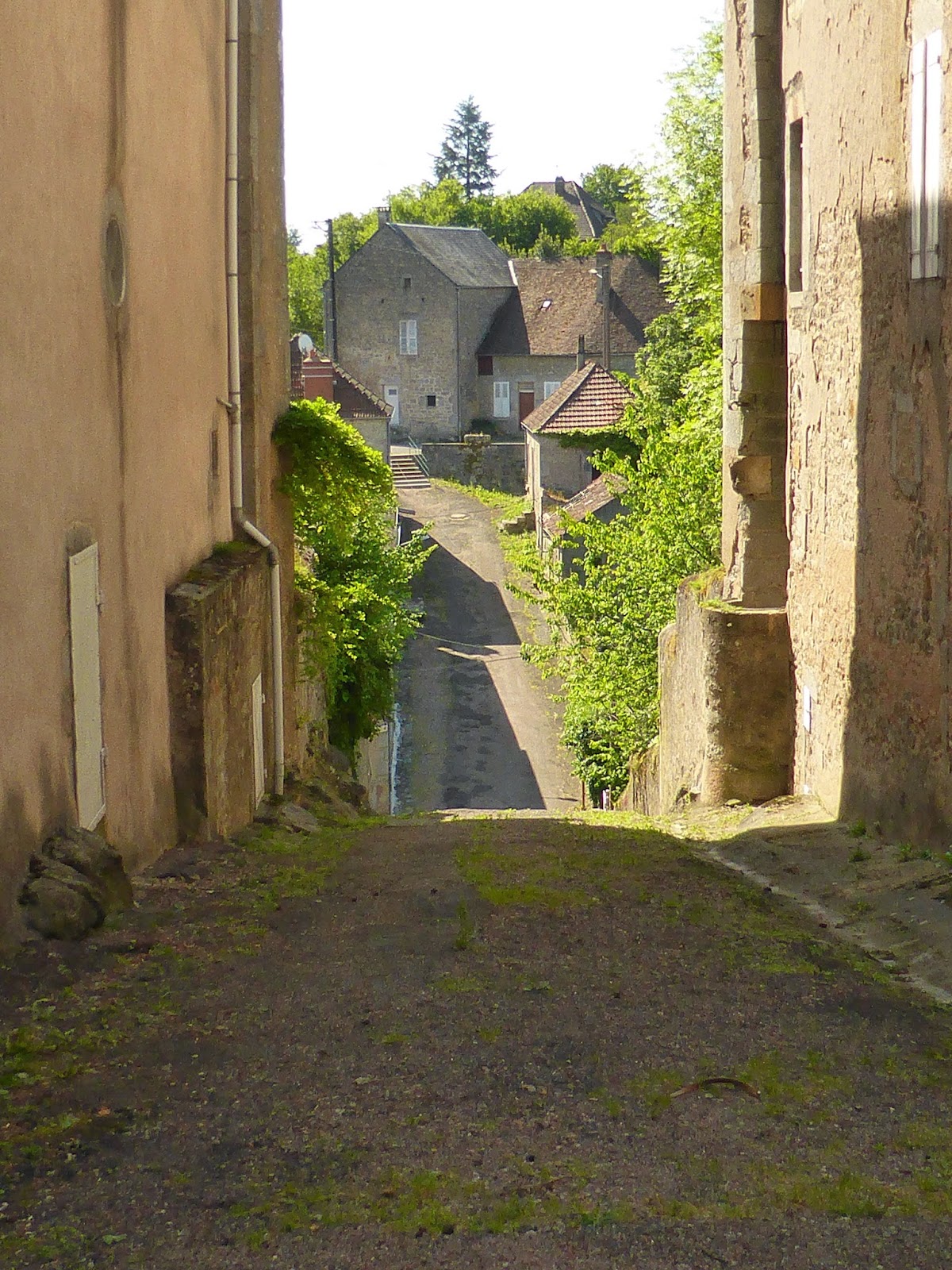
We spent a couple of nights in Lormes, a small town with an
excellent Dutch-run camp site by the Etang Du Goulot, a popular swimming spot. There are walking routes from the town,
including through the Gorges de Navau.
The town was celebrating Pentecost with a fun fair and fireworks and we
walked up to the church at 23.00 on the Monday to see these. We joined a small selection of town dwellers sitting
on the cemetery wall to watch the firework spectacular; the pyrotechnic experts
were behind their red and white tape organising the show. It was soon apparent that small pieces of
burning firework were landing on to the crowd; some of us became alarmed at
this and moved further in to the cemetery.
At the end everyone clapped and we left crunching over glowing pieces of
fireworks.
| Walking near Lormes |
We drove further
south in to the Auvergne Region and the amazing landscape around
Clermont-Ferrand and the Parc des Volcans d’Auvergne, dotted with puys, the
steep-sided hills that are extinct volcanoes.
We drove through Orcival, a small village south of Clermont-Ferrand
which we were surprised to find featured in our Rough Guide or Guide to
churches as we like to call it. Before
giving the detail of the Romanesque church, the Rough Guide did tell us that
Orcival was the birthplace of President Valery Giscard D’Estaing. Two Presidential connections in a couple of
days has got us wondering how many French Presidents there have been.
Through France to the Pyrenees One: Drug smuggling and finding our way
Carol fell while in Orkney, ten days before we set off for
France, and while taking part in the extreme sport of self-timer
photography. The resulting pain at the
bottom of her rib cage had not eased by the day before we left and so Salford
Royal’s Emergency Department was consulted.
Damage to her Costal Cartilage was diagnosed, painkillers prescribed and
rest was recommended for three or four weeks to allow it to mend. Carol came away from Salford Royal with a
month’s supply of Codeine and unsure how rest fitted in with a walking and
cycling holiday.
| A perfect lunch stop |
The Codeine seemed a bit of an over-kill so we packed it and
decided to stock up on Paracetamol and Ibuprofen and try taking these combined three
times a day and carry on regardless; for three and a half weeks we needed over
75 of each. Supermarkets limit the
number of Paracetamol to 32 in one purchase but self-checkout allows anyone to
get around this. Buying enough 400mg
Ibuprofen needed the two of us to separately buy a pack of 48 to get past the
Pharmacist regulations.
Having managed to purchase such large quantities of pain
killers we reached Hull and here the customs officials picked out our van to
search. While one official checked the
engine compartment with Anthony, Carol had a body search and then had to show
the contents of the cupboards in the van.
We wondered if the supermarket had tipped them off but apparently they
were only looking for people and we managed to smuggle all the drugs in to
Belgium without being caught.
From Zeebrugge our first stop was Sezanne in the Champagne
Region. The weather was already hot and
sunny; we were enjoying eating outside and only needing shorts and
t-shirts. A new toy for 2014 was another
sort of tablet, a Google Nexus, on to which we had loaded the OsmAnd maps of
Belgium and France for driving, walking and cycling navigation. We had tried various free open-source maps before
coming on holiday and we had found that OsmAnd suited our needs best. It quickly showed its usefulness when we
found a lovely spot by a ruined abbey for our lunch break on our first day.
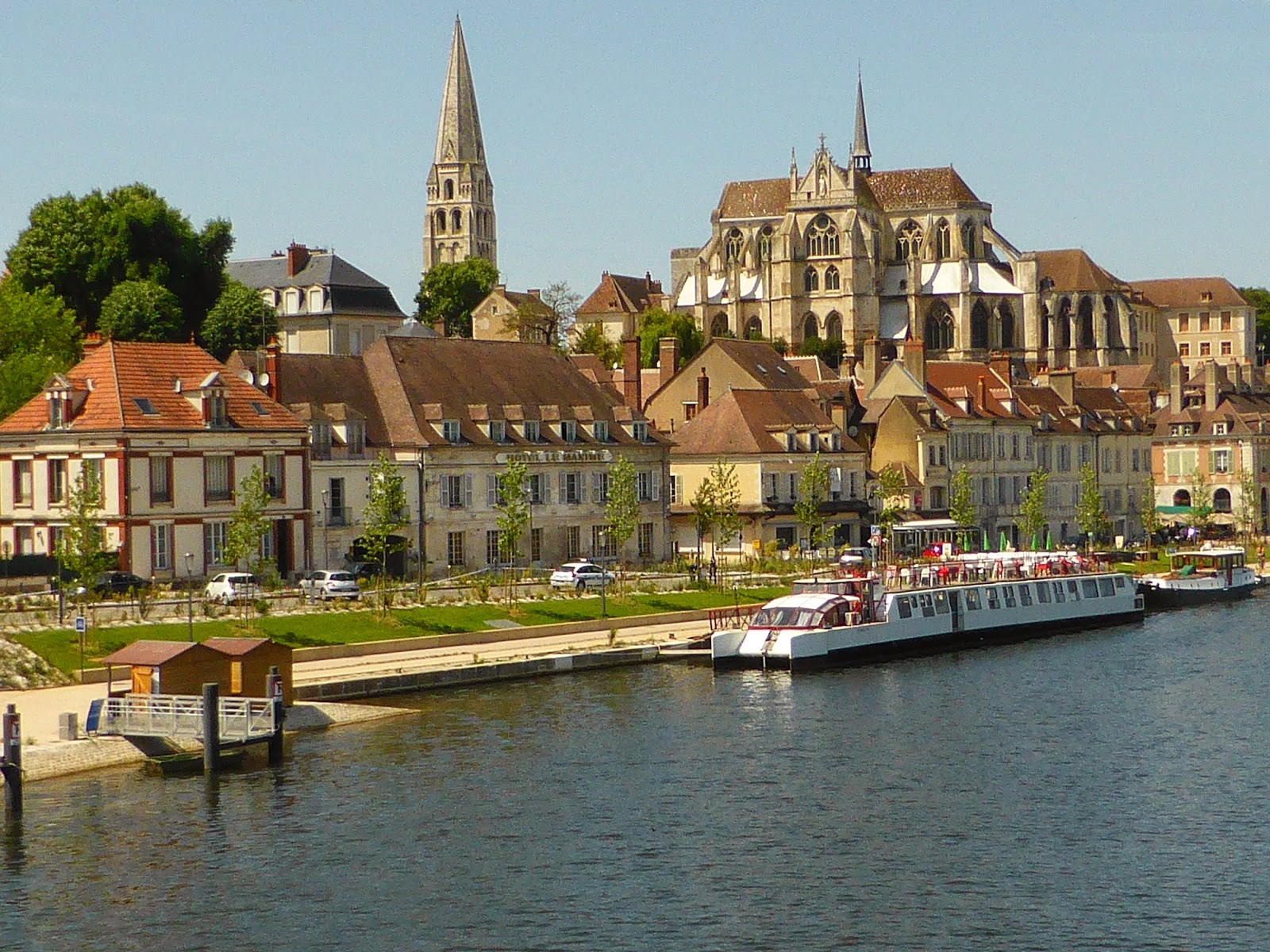
| Auxerre river front |
Excited by the possibilities of the new toy we changed some
of the settings including asking it to navigate the shortest route, rather than
the fastest. We left Sezanne on a
pretty country lane that got narrower and narrower until we reached a gate
beyond which access in to the forest was prohibited. We back-tracked, sneaking past the camp site
and put the diversion down to a learning experience.
OsmAnd knows the speed limits of the roads and gives a
warning if they are exceeded, calculates our time of arrival, uses GPS to tell
us where we are, locates the shops and parking for us and gives us confidence
to drive in to towns and cities without getting lost or hopelessly confused. On our second day we used OSMand to drive in
to Auxerre, find the parking by the river and enjoy a few hours exploring this
beautiful town.
Friday, 6 June 2014
France 2014 trip camp sites used
|
Campsite name
|
Number of nights
|
Comments
|
Cost
|
|
Sezanne Municipal Camp Site
|
1
|
Sloping grassy site on the edge of a
small town by sports facilities, facilities clean and good, wash up outside
|
£11.00
|
|
Camping de L'Etang du Goulot, Lormes
|
2
|
ACSI By a lake, marked grassy
pitches, facilities clean and modern, good showers, cafe, mini golf and on
edge of village
|
£14.50
|
|
Les Domes, Nebouzat, near
Clermont-Ferrand
|
1
|
ACSI Facilities dated but clean,
showers warm push button, grassy site, some road noise, friendly staff
|
£14.00
|
|
La Panoramique, La Bourboule
|
3
|
ACSI Lovely views across the valley,
good size pitches and maked, grassy, clean facilities, washing up and laundry
indoors, showers good flow, could be hotter
|
£14.00
|
|
Camping Bouthezard, Le Puy en Velay
|
1
|
ACSI 10 minutes walk in to town,
small site, friendly owner, somewhat unkempt site, good showers, need
cleaning, no toilet paper, grassy with trees, grass long
|
£14.00
|
|
Camping Le Val Saures, Entraygues sur
Truyere
|
3
|
ACSI No toilet seats, toilet paper,
clean facilities, large site by the river Lot, peaceful, good size marked
grassy pitches, good showers, plugs at sinks and proper taps, 5 minutes from
town and shops
|
£12.00
|
|
Le Moulin, Martres-Tolosane
|
1
|
ACSI Large pitches were €3 extra,
10amps was €2 extra, marked shady pitches, good clean facilities, pool &
bar, quiet spot
|
£16.00
|
|
Le Pain de Sucre, Gavarnie
|
1
|
3kms from village and uphill walk,
well kept site with good clean facilities & hot showers, bread &
lovely views
|
£15.70
|
|
Le Trois Vallees, Argeles-Gazost
|
3
|
ACSI Noisy building work, some
pitches by the road, pitches not very generous, flat & grassy, showers
like a designer bathroom but no toilet paper & by a Voie Verte
|
£16.00
|
|
Le Camp de Florence, La Romieu
|
2
|
ACSI Large site, next to a very
pretty village, pitches marked & shaded, facilities very clean, toilet
paper, pleasant bar
|
£16.00
|
|
Camping Brantome Peyrelevade
|
1
|
ACSI Large site with grassy marked
pitches, some very shaded, facilities clean, showers not very warm, near
touristy town, pool
|
£15.00
|
|
Camping Ile D'Offard, Saumur
|
2
|
ACSI Large site on an island in the
Loire, 20 mins walk from Saumur, facilities clean, showers roomy, pitches
marked & grassy with some shade
|
£15.00
|
|
Domaine de Marcilly, Marcilly sur
Eure
|
2
|
ACSI Grassy site in wood, with marked
hedged pitches, 2kms from village, fresh bread, facilities clean with toilet
paper but showers cool
|
£18.00
|
|
Camping La Paille Haute, Boiry Notre
Dame
|
1
|
Grassy site with sloping pitches,
unmarked and narrow, unisex facilities OK
|
£23.00
|
Monday, 2 June 2014
We are back!
| Delamere Forest Camping & Caravan Club site |
It is quite a few months since we last posted on the Blog (if you are counting it is almost nine months!) The time has flown and although we have done some lovely things during the last nine-months the lack of posts is a lot to do with a couple of incidents that happened in 2013 that disrupted our lives somewhat.
Firstly, Anthony was run down by a car while walking to work; this required a hospital stay and surgery to his left-hand which is now much better, although he will never get full use back. He wasn't able to drive for about four weeks. We had no sooner started to recover from this and Anthony's Dad died; this sad event meant that we were pre-occupied with sorting out his estate (nothing grander than a semi-detached house). Add in to this mix Carol changing jobs and you will not be surprised that the Blog has not been a priority.
| Cragside |
| Cycling near Formby |
We have had some lovely weekends away with friends in Delamere Forest and the Peak District and we met up with the Devon Owners Group at Harbury again in May; this was a great weekend meeting new and old friends and seeing how everyone has made their van their own.
As a couple we had a long weekend around Northumberland, which included a beautiful sunny day at Cragside; the weather was so good we never even went to the National Trust tea shop. We cycled some of the excellent cycle routes around Southport and spent some time in Scotland at Easter which included staying at the camp site in Ullapool which we had last camped at in 1981!
Our next European tour is only a few days away now and we can't wait, so watch this space, the next post will be from France.
Saturday, 28 September 2013
Where do you put everything?
We are often being asked how we manage to fit everything in to the Blue Bus, so I thought it was time to put together a post with some of the space saving ideas we have had over the years and some of the ways we have made the most of the space in the van.
Modifications to cupboards
Making best use of the space we have
Other additions
How do you fit everything in your van?
Modifications to cupboards
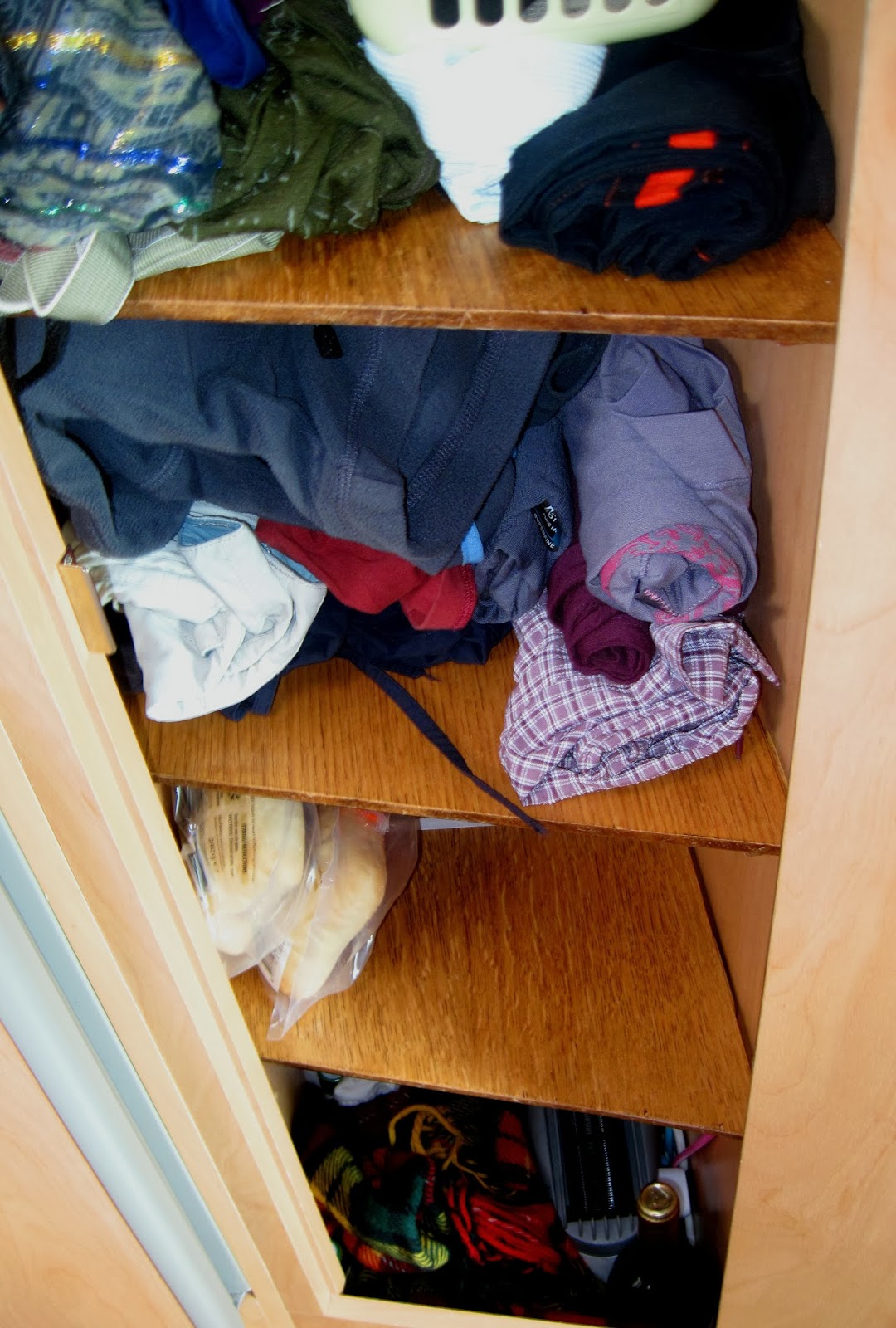
- Added three shelves to the wardrobe which still leave a large space at the bottom where we can fit the portable fan heater and bottles of wine
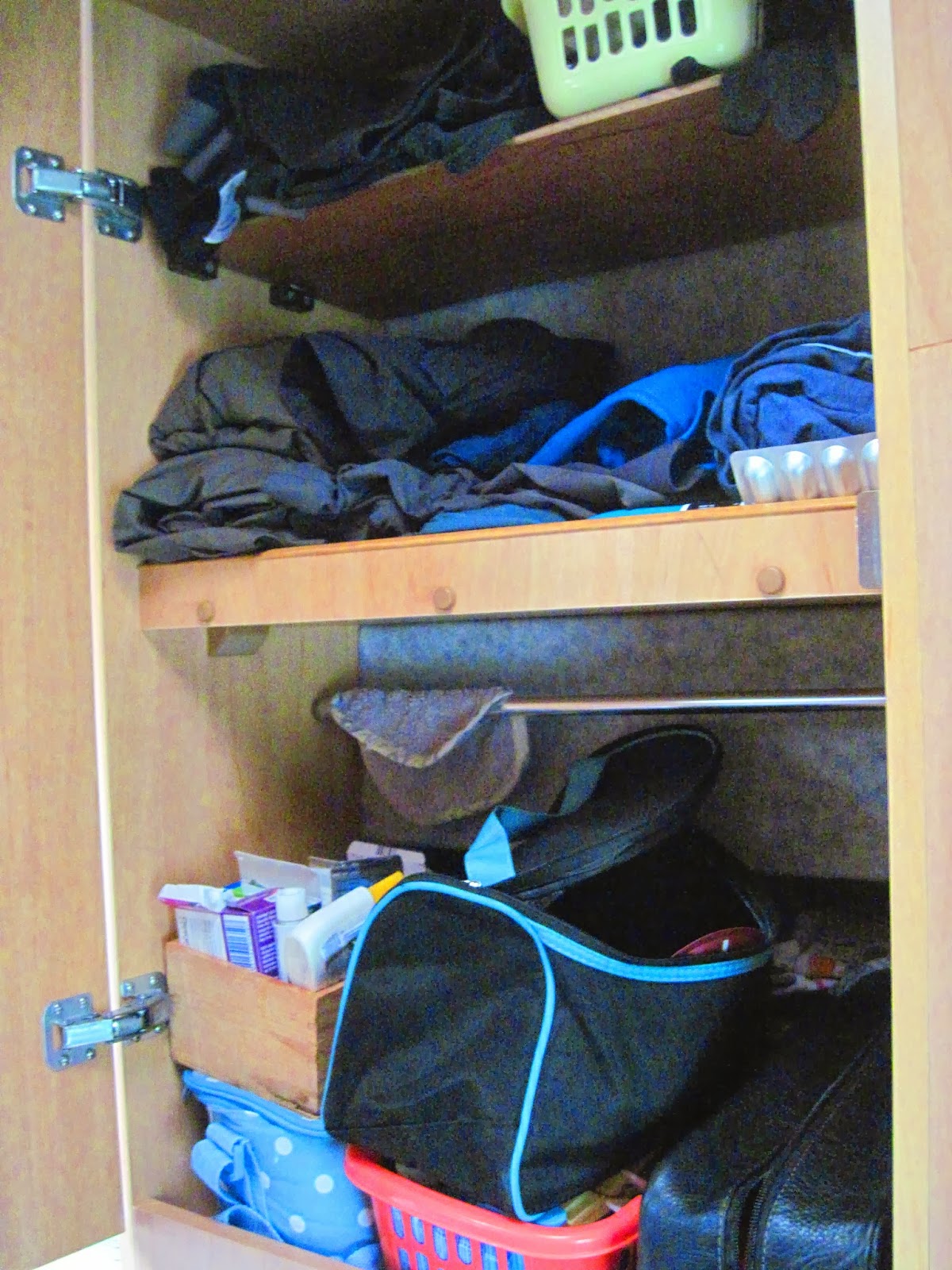
- Added a shelf to the top half of the large cupboard above the fridge where we keep clothes
- Added a shelf and partition to the cupboard under the cooker for food, towels and teapot, kettle etc.
- We also use plastic baskets and boxes to keep items separate and organised
| The wardrobe |
| Cupboard above the fridge |
| Cupboard under the cooker |
Making best use of the space we have
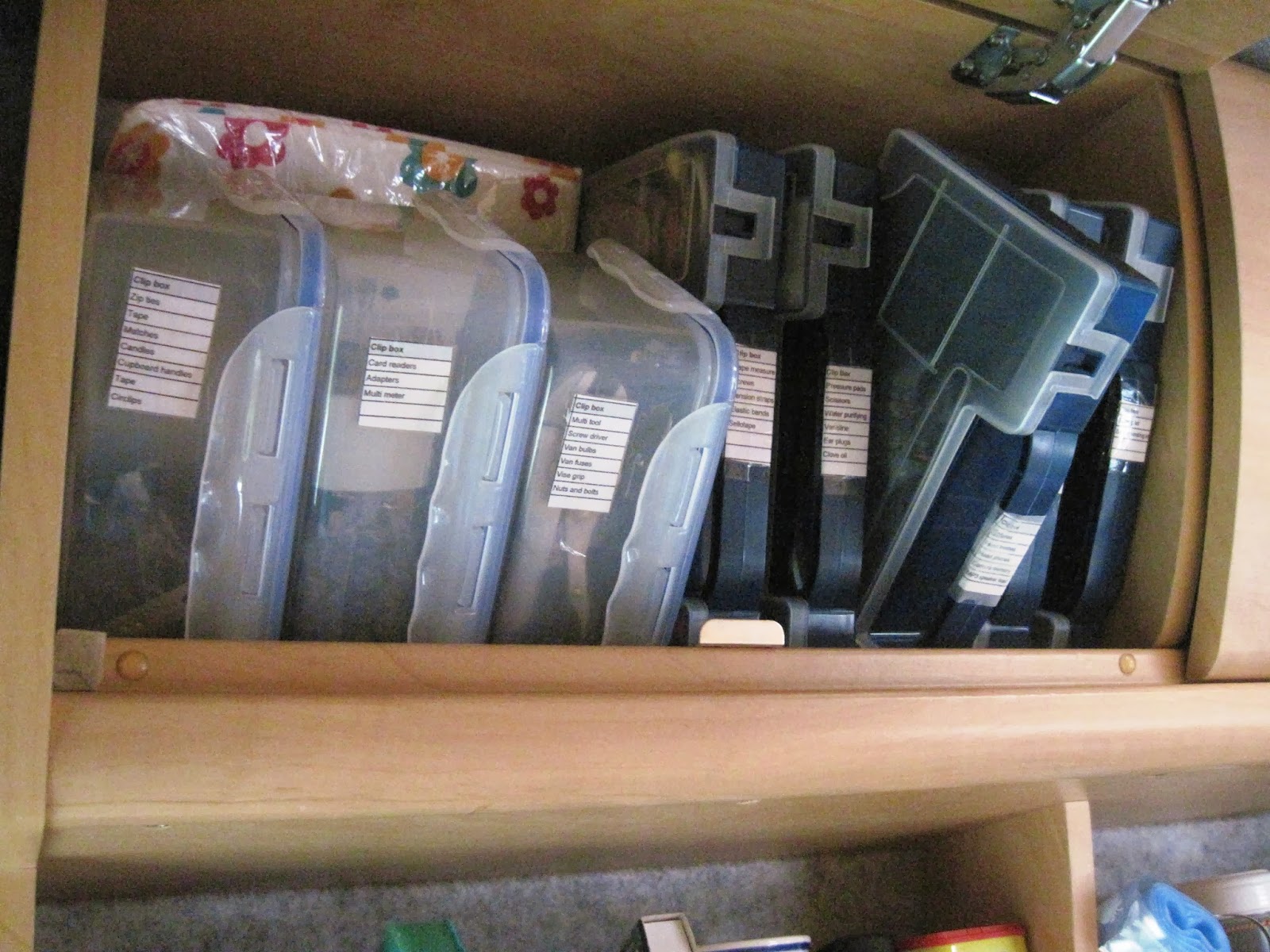
- Fishing tackle boxes for small items and tupperware boxes all labelled (because we are always forgetting what is in them) for one of the high cupboards
- Ikea tins for food and above these spare tea bags in a laundry net held in place with hooks
- Travel size games in the narrow shelves in the high top
| Fishing tackle boxes and tupperware clip boxes are labelled so we remember what is in them |
| The net holds the boxes of tea bags so they don't fall on to my head |
| Scrabble, back gammon, cards, cribbage & dominoes |
Other additions
- Specially made carriers for our Crocs, handily placed at the back door and made from Wilkinsons car plastic waste bins and a piece of wood.
- Nets on the front of the over cab cupboard door
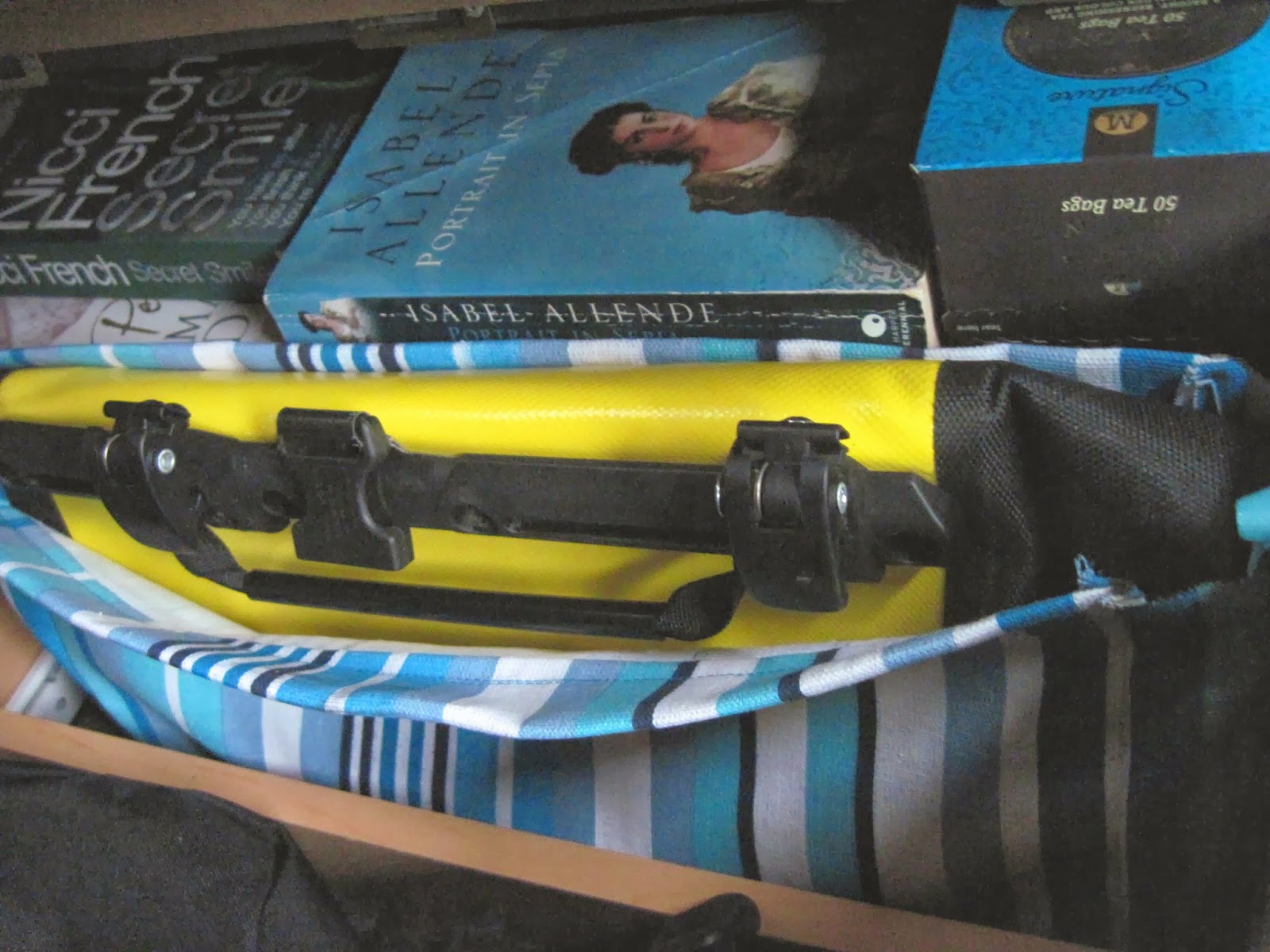
- Under the off-side passenger seat, books and more spare tea bags fit on top of the heater and a specially made bag hooks in the narrow gap between this and the back of the under seat drawer to fit a bicycle pannier.
| Our Crocs are always handy |
| The bike pannier fits neatly under the passenger seat |
How do you fit everything in your van?
Saturday, 31 August 2013
Summer lovin' happened so fast
| Point of Ayr, North Wales |
A weekend in Moreton-in-Marsh in June was memorable for the number of nettle stings and scratches we both suffered from after battling through a little used and overgrown path.
We had a long weekend around the north Pennines with hot and sunny weather; we climbed Cross Fell, which seemed to be the only cold and windy place in the UK that day.
We returned to Howgill Lodge in Wharfe Dale for a weekend and found a walk from the site we hadn't done before, stayed at a lovely site near Hesketh Newmarket for some walking on the quieter northern Lake District fells, perfect for busy August weekends and camped in Prestatyn, so that we could cycle along the north Welsh coast on the National Cycle Route number five.
Over the bank holiday weekend we travelled down to the Brecon Beacons for some more hill walking, by now feeling fit and able to tackle 20km+ walks.
If only it was summer all the time.
| Simon's Seat above Wharfe Dale |
Saturday, 15 June 2013
We always had a ball on Mars
Marburg has had a university for almost 500 years and clearly takes its responsibility of education seriously and has built a planetary learning path that followed our cycle route south out of this stunning town. The planets are spaced apart at a scale where 1m on the ground represents one million kms in space; this means that the outer planets are spaced a long way from each other but as you get nearer to the sun they come thick and fast and we sped past Earth, Venus and Mercury in seconds.
The villages we cycled through all had narrow winding lanes and wooden framed houses in deep brown and white with impossibly tidy gardens and well swept farm yards. The farmers were busy in the fields and we met a number of tractors, who share the lanes between the fields with the hordes of cyclists out on a fine Saturday.
Marburg itself rises steeply up the hill from the river Lahn and the story is there are 400 steps up to the castle right at the top of the town. On the way you walk up cobbled streets surrounded by colourful wooden framed houses; the town is straight out of a Grimm's Fairy Tale an is that childhood version of Germany and this isn't surprising, as the Brothers spent three years studying here in the early 19th Century. The town survived the war without bombing, as it was designated as a hospital town and has since had enlightened town planning that has protected the buildings and local environment.
The villages we cycled through all had narrow winding lanes and wooden framed houses in deep brown and white with impossibly tidy gardens and well swept farm yards. The farmers were busy in the fields and we met a number of tractors, who share the lanes between the fields with the hordes of cyclists out on a fine Saturday.
Marburg itself rises steeply up the hill from the river Lahn and the story is there are 400 steps up to the castle right at the top of the town. On the way you walk up cobbled streets surrounded by colourful wooden framed houses; the town is straight out of a Grimm's Fairy Tale an is that childhood version of Germany and this isn't surprising, as the Brothers spent three years studying here in the early 19th Century. The town survived the war without bombing, as it was designated as a hospital town and has since had enlightened town planning that has protected the buildings and local environment.
Friday, 14 June 2013
Down up pedals, down up down
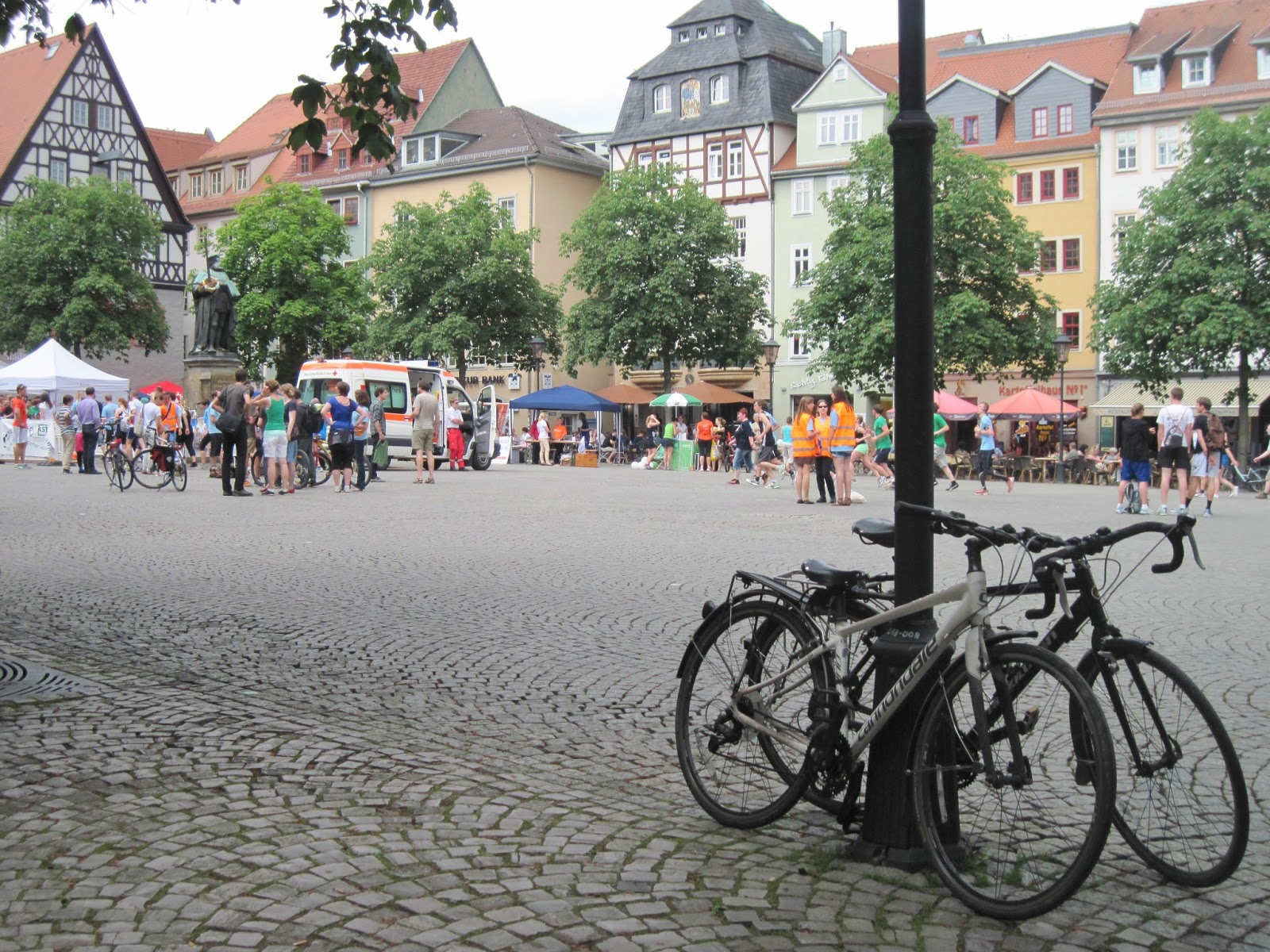
The first time you cycle the wrong way down a one-way street in Germany is slightly nerve-wracking but you soon get the hang of it and are soon cycling on pavements and expecting cars to give way to you, like any other German cyclist.
Jena is a lively and bustling town, with a large university and the Carl Zeiss factory; Carl Zeiss started making high quality lenses in the mid-nineteenth century in Jena. Jena had cyclists of every persuasion; cyclists with bags of shopping over their handlebars, cyclists towing trailers containing dozing young children, cyclists on battered heavy bikes and even cyclists in lycra. The cycle routes leave the town to the north, south, east and west and we had intended to follow the river Saale route north or south. However, Jena was one of the towns affected by the recent floods and although it was now hot and sunny, the river cycle paths were still reported to be muddy and so we decided to cycle to Weimar and back, a round trip of 48km of up and down.
Weimar proved to be an excellent choice; it was such a pleasant and pretty town and we learnt about it's place in German culture and history and why a small town in central Germany was chosen as the base for the Weimar Republic after the first world war. The cycle route was well signed and took us through pretty small villages, entering the Unesco World Heritage Site of Weimar through the wonderful Ilm Park and the popular attraction of Goethe's Garden House. We never like to over-do the culture and concentrated on finding a good Eis Cafe in Weimar, as it was just the weather to enjoy icecream.
In our last post we mentioned Mini Camping in Karlovy Vary as being small and perfectly formed and this was closely followed by another gem of a camp site in Jena; again small but clearly designed by a camper and a peaceful haven with everything we needed.
Jena is a lively and bustling town, with a large university and the Carl Zeiss factory; Carl Zeiss started making high quality lenses in the mid-nineteenth century in Jena. Jena had cyclists of every persuasion; cyclists with bags of shopping over their handlebars, cyclists towing trailers containing dozing young children, cyclists on battered heavy bikes and even cyclists in lycra. The cycle routes leave the town to the north, south, east and west and we had intended to follow the river Saale route north or south. However, Jena was one of the towns affected by the recent floods and although it was now hot and sunny, the river cycle paths were still reported to be muddy and so we decided to cycle to Weimar and back, a round trip of 48km of up and down.
Weimar proved to be an excellent choice; it was such a pleasant and pretty town and we learnt about it's place in German culture and history and why a small town in central Germany was chosen as the base for the Weimar Republic after the first world war. The cycle route was well signed and took us through pretty small villages, entering the Unesco World Heritage Site of Weimar through the wonderful Ilm Park and the popular attraction of Goethe's Garden House. We never like to over-do the culture and concentrated on finding a good Eis Cafe in Weimar, as it was just the weather to enjoy icecream.
In our last post we mentioned Mini Camping in Karlovy Vary as being small and perfectly formed and this was closely followed by another gem of a camp site in Jena; again small but clearly designed by a camper and a peaceful haven with everything we needed.
She said the man in the gabardine suit was a spy
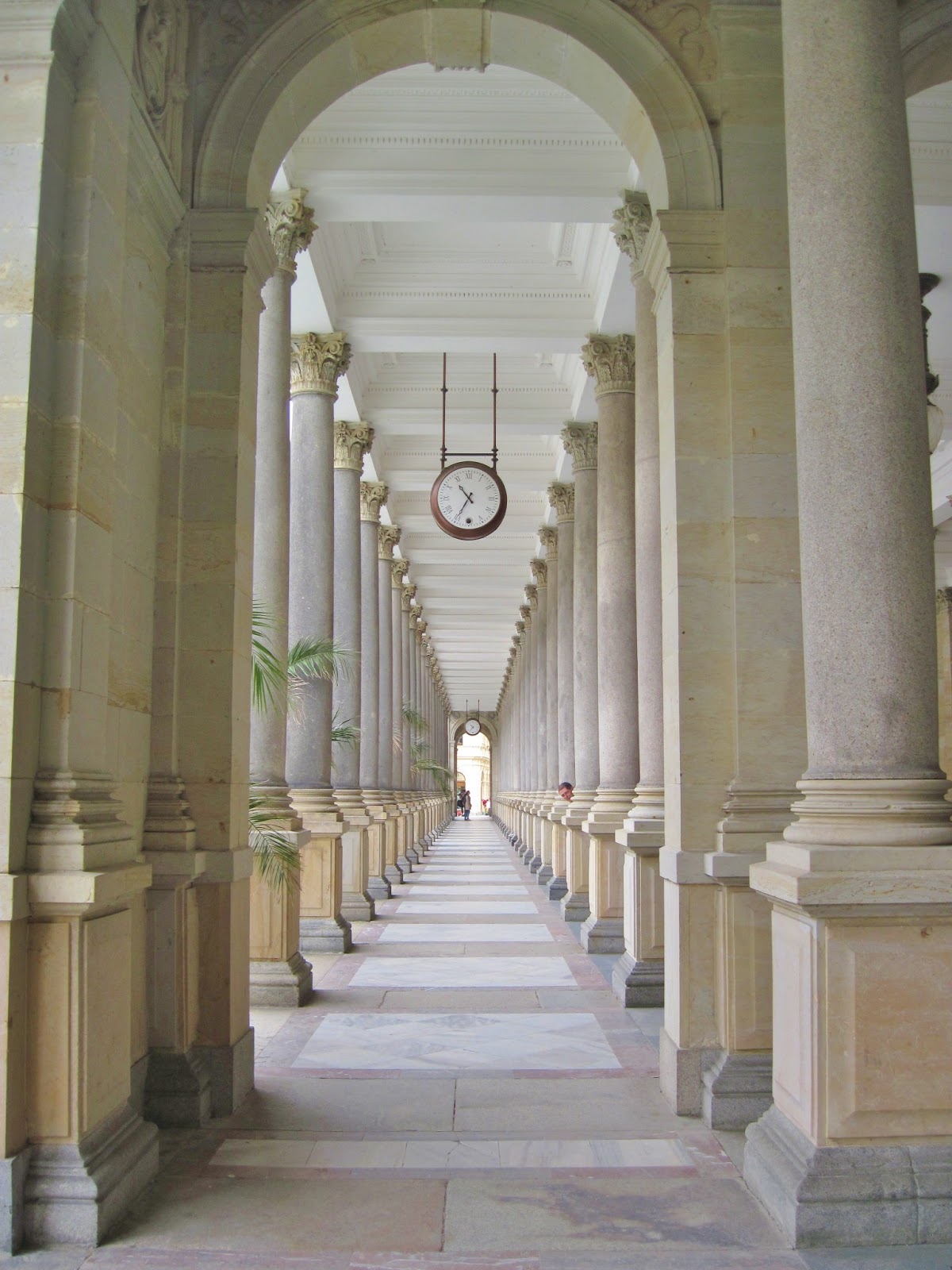
Spa towns in continental Europe always have an atmosphere of
indulgence and repose and none more so than Karlovy Vary in Bohemia in the
Czech Republic. Previously a German
speaking town and called Carlsbad under the Austro-Hungarian rule, this small
town packed so many fanciful and elaborate buildings in to one town, it took
our breath away.
For the tourists, this is all lots of fun and provides ample
opportunities for people watching; that man in the dark suit and mobile phone
looks straight out of a Russian thriller, the woman sitting reading an ebook in
the steamy room with the geyser looks like she has come to Karlovy Vary to
forget an unhappy love affair and which country were the couple in the matching
shell suits from?
The appropriately named Mini Camping in Karlovy Vary is a
small and perfectly formed camp site, the like of which you rarely find. We had a pitch next to the fish pond and were
fittingly lulled to sleep by the sound of the adjacent fountain.
Die Fahrbahn ist ein graues Band
We have already driven over 2,000 miles on this trip and
will probably pass 3,000 before we get home to Greater Manchester. In those miles we have travelled on roads in
six different countries outside the UK.
These countries are all in Europe but the differences in their infrastructure
has been very marked.
Both Germany and Austria appear to be building new roads and
repairing old ones like there is no recession and of course it may be no coincidence
that in these countries the economy has remained more stable. In Slovakia too, although many of the village
roads were in a poor state, new sparkling motorways were being built so that
lorries can hurtle across the country to Ukraine and Russia.
Living in Greater Manchester in 2013, we thought we had got
used to potholed roads, but Hungarian roads have given us a new
perspective. The motorways we used in
Hungary were good and not heavily used but many of the roads in towns and the
countryside were so potholed and broken up that the bouncing of the van forced
our CD player to give up and it refused to play any more music until we were
back on terra firma; we soon learnt that the only way to deal with some of
these roads was to weave around the potholes, stick to the middle of the road,
which would sometimes be less eroded or drive on the wrong side of the road, if
that surface was better.
In the Czech Republic the town and country roads were either
not too bad or we had now decided that pot holes were normal. However, the motorways were built out of
concrete slabs and we bumped our way rhythmically across the country back in to Germany ... where we could mention the cobbled streets in the old DDR.
Labels:
Austria,
Czech Republic,
Germany,
Hungary,
Slovakia
Saturday, 8 June 2013
Getting older, looking back, still the fact is nothing changed at all
I visited Levoca in Slovakia 21 years ago, with a very young
Matthew and Mark and loved the faded grandeur of the town square. On that visit we arrived by bus from the
Tatras and met a waitress in a cafe who spoke English and was vegetarian and
helped us find a suitable lunch.
Renovating Levoca after the years of neglect since the 17th
Century was going to be a long process but I knew I would be back to see the
progress.
This time we got to the town by walking along the valley from the campsite 2km
away. The campsite is terraced on a
steep grassy hillside and as readers may have heard there has been heavy rainfall
in central Europe that has caused floods along the Danube and so the field was
muddy in places. In adversity, campers
help each other and on our last site in Hungary, we became comrades with couples
from the Netherlands and France, as we sought pitches that were solid enough for
a van on the otherwise empty camp site.
In Levoca, there were already two caravans from the
Netherlands and a German camper in a VW and they all wanted to help us find the
best pitch. Together, we identified a
suitable route through the site to a pleasant pitch only to find our 35m of
electric cable would not reach a vacant connection. After a considerable amount of discussion in
various languages, I was dispatched to ask the Slovakian camp site owner, who
spoke a little German, if he had a longer cable, although I didn’t know the word
for cable in either Slovakian or German.
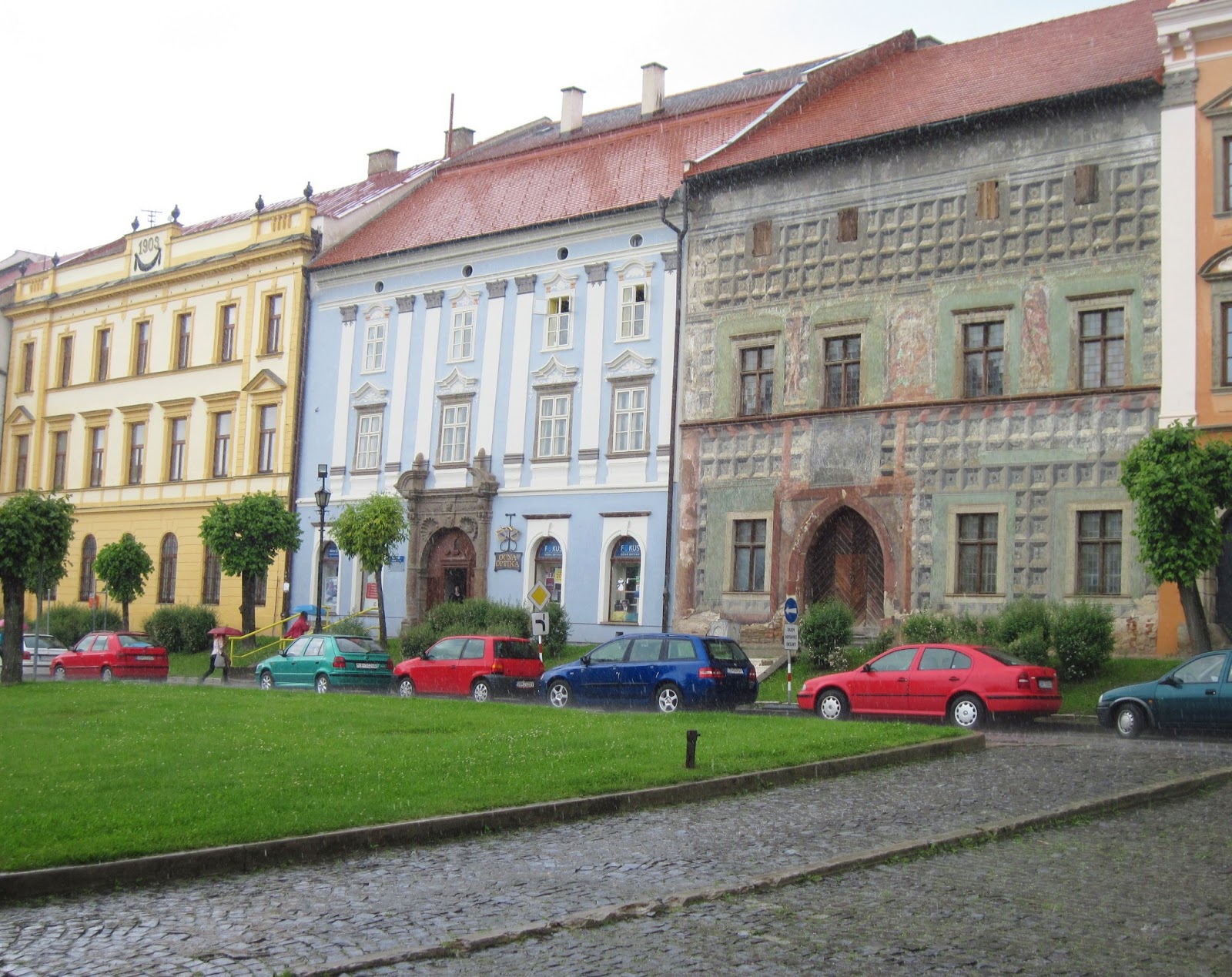
The beautifully decorated Renaissance houses in the square
of Levoca are now mostly restored to their former glory, although there is
still scaffolding on one of the churches in the centre and improvements to the road surface being made. The town walls are still splendid, the cage
of shame for local wrong doers is still there and there are more cafes than
there were in 1992.
Subscribe to:
Posts (Atom)